

The stock photo market generates over $4 billion annually, and a growing slice of that revenue goes to contributors shooting on smartphones rather than DSLRs. Selling stock photos from your phone isn’t a fringe strategy anymore — platforms like Shutterstock, Adobe Stock, and Alamy actively accept mobile photography, and buyers don’t care what camera you used as long as the image is sharp, well-composed, and commercially relevant. The barrier isn’t your equipment. It’s whether you understand what buyers actually need.
What New Stock Photographers Get Wrong From the Start
Most people submit what they find beautiful. Buyers purchase what they find useful. Those are two different things entirely. A stunning sunset over the ocean has roughly 4 million competitors on Shutterstock already. A clean overhead shot of a laptop, coffee, and notebook on a wooden desk — that gets licensed by bloggers, marketers, and content teams every week because it’s functional, not just attractive.
The mindset shift that separates contributors who earn consistently from those who upload 50 photos and get discouraged is simple: shoot for the buyer’s workflow, not your aesthetic preference. Commercial stock photography is a product business, not a portfolio exercise.
How to Build a Stock Photo Income Stream From Your Smartphone
Step 1: Research before you shoot — not after.
Spend 30 minutes on Shutterstock or Adobe Stock searching the categories you’re thinking about shooting. Sort results by “Most Popular” or check the editorial trending section. Pay attention to what’s getting licensed: the composition style, the lighting, the negative space for text overlay. Buyers use stock images for blog headers, social posts, presentations, and ad campaigns — they need clean, uncluttered images with room to add copy. Shoot with that specific use case in mind from the first frame.
Step 2: Shoot in a niche, not across every category.
Contributors with 200 tightly focused images in one niche consistently outperform those with 2,000 scattered images across every category. Niches with consistent commercial demand include remote work setups, small business and entrepreneurship visuals, food preparation, wellness and fitness, and diverse representation in everyday contexts—the last of which remains significantly undersupplied relative to buyer demand. Pick one niche you can photograph authentically and build a coherent portfolio within it. Alamy in particular rewards contributors whose collections have thematic depth.
Interestingly, many stock photo creators also use short-form video platforms to promote their work and build an audience. That strategy is explored in TikTok Domination 101: The No-BS Guide to Rapid Growth This Year, where creators learn how to grow visibility quickly.

Step 3: Understand the royalty structures before choosing your platforms.
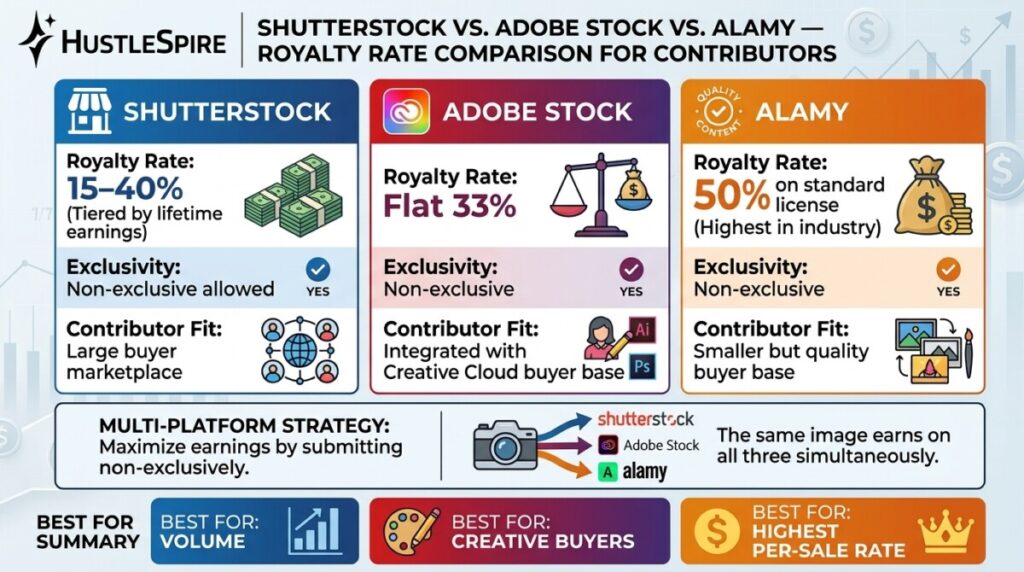
Shutterstock pays contributors 15–40% royalties depending on your contributor tier—starting at 15% per download, increasing as your lifetime earnings grow. Adobe Stock pays a flat 33% on photos. Alamy pays 50% on its standard license, which is among the highest in the industry and worth prioritizing for photographers willing to build volume there. Uploading to multiple platforms simultaneously is the standard approach — most platforms allow non-exclusive submissions, meaning the same image can earn on Shutterstock, Adobe Stock, and Alamy concurrently.
Step 4: Metadata is where most phone photographers leave money on the table.
Your title, description, and keyword tags determine whether your image ever surfaces in a buyer’s search. Each upload needs a descriptive title, 2–3 sentences of specific description, and 20–50 relevant keywords. Tools like Xpiks help batch-process metadata across platforms efficiently — a genuine time investment that directly affects discoverability. Weak metadata on a strong image earns nothing. Strong metadata on an average image at least gives it a chance.
What to Expect
Stock photography income is slow to build and requires genuine volume to become meaningful. A portfolio of 100 images typically earns $10–$50/month in passive royalties. At 500 well-optimized images in a focused niche, that range moves to $100–$300/month for many contributors. Reaching a consistent $500+/month income generally requires 1,000+ quality images and 12–18 months of steady uploading. This is a long-horizon side hustle, not a fast cash strategy. The income is genuinely passive once the portfolio is built, but building it requires sustained effort that most people underestimate at the start.

Open Shutterstock’s contributor portal today and browse the top 50 images in one category you could realistically photograph this week. Note the composition patterns, color tones, and subject types that repeat across high-performing images. Then take 10 shots this week in that style — not for upload yet, just to test whether your phone produces technically acceptable quality in that category. One focused session of research and shooting tells you more about your potential in this space than any amount of reading about it.
Selling smartphone photos is just one of the many ways people are earning online without expensive equipment or years of experience. Another example is explained in The Remote OK Job Board Secret: Landing $50/Hour Gigs Without Experience, which shows how beginners are finding surprisingly high-paying remote work.
