

Most people scroll past Remote OK thinking it’s only for senior developers or specialists with five-year portfolios. That assumption is costing them real money. Remote OK job board listings regularly include entry-level and project-based roles in content writing, virtual assistance, social media management, and customer support — many paying $40-$60/hour — and the competition on this platform is significantly lower than on Upwork or Fiverr. Understanding how to position yourself on Remote OK is the real starting advantage.
What Job Seekers Get Wrong About “No Experience” Applications
The common mistake is treating Remote OK like a traditional job board — sending the same generic resume to 20 listings and waiting. That approach fails here for the same reason it fails everywhere: companies posting on Remote OK are lean, often founder-led teams that make hiring decisions fast and personally. They’re not running applications through an HR department.
What actually gets responses is specificity. A message that demonstrates you understand exactly what the company does, references a specific problem visible on their website or product, and proposes a concrete way you’d solve it — that gets read. A PDF resume with an objective statement does not. The bar isn’t your experience level. It’s whether you sound like someone who’s actually paying attention.
Landing Remote OK Jobs at $50/Hour: The Practical Approach
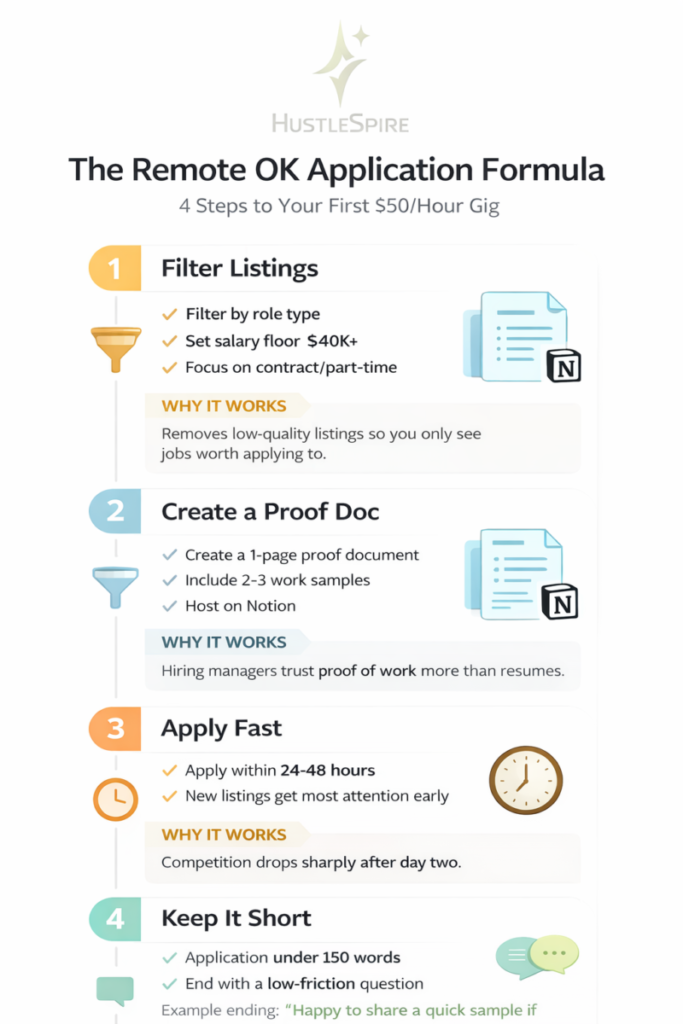
Step 1: Filter by role type, not just pay rate.
Remote OK lets you filter listings by category — writing, marketing, design, support, operations. Start with categories where transferable skills apply broadly. Content writing, for example, doesn’t require a journalism degree. Customer support roles often explicitly state “no experience required.” Use the salary filter to set a floor of $40,000/year (roughly $19-$20/hour full-time equivalent) and look for contract or part-time designations, which frequently translate to higher hourly rates than the annual figure suggests.
Step 2: Build a one-page proof document, not a resume.
Instead of a traditional CV, create a single-page document that shows rather than tells. Include two or three work samples — even self-initiated ones count. A spec article you wrote for a fictional brand, a social media audit you ran on a real company’s public account, a short customer support email thread you drafted as an exercise. Tools like Notion make it easy to build a clean, linkable portfolio page at no cost. Hiring managers at remote-first companies respond far better to a Notion link than a Google Doc attachment.

Step 3: Apply within 24-48 hours of a listing going live.
Remote OK shows listing timestamps. Roles posted within the last 48 hours receive significantly less competition than listings that have been up for a week. Set up a daily check or use Remote OK’s email alerts to get notified when roles matching your filters go live. Speed matters more than polish at the application stage — a good enough message sent on day one beats a perfect message sent on day five.
Step 4: Use the application to start a conversation, not close a deal.
The goal of your first message isn’t to get hired. It’s to get a reply. Keep your initial application to 150 words or fewer. Mention one specific thing about the company, explain what you’d bring to the role in one sentence, and include your proof document link. End with a single low-friction question — something like “Would a short trial project make sense as a starting point?” This approach works because it reduces the perceived risk for a small team that can’t afford a bad hire.
Want ideas that actually sell? Don’t miss The Fiverr Gigs Nobody’s Selling (But Buyers Are Desperately Searching For).
What Slows People Down
Realistically, most people applying consistently — 5-7 targeted applications per week — see their first positive response within 2-4 weeks. Landing a paid gig typically takes 4-8 weeks from starting point, assuming no prior freelance history. The slowdown usually isn’t rejection — it’s inconsistency. People apply for three days, hear nothing, and stop. Remote job markets move in cycles. Some weeks are dry. Some weeks three companies reply at once. Additionally, be aware that some Remote OK listings are aggregated from other sources and may be outdated — always verify the listing is still active before investing time in a tailored application.

Go to Remote OK today and set filters for your skill category and a minimum salary range. Find one listing posted within the last 48 hours that genuinely interests you. Then spend 30 minutes building a 150-word application that references something specific about that company and links to one work sample — even a self-created one. Send it today. The feedback loop from real applications teaches you faster than any course on freelancing ever will.
After learning how to land $50/hour gigs, see which path scales better with Freelancing vs Side Hustling: Which One Scales Better?
