

Upwork takes up to 20% on your first $500 with a client. Fiverr takes 20% on every transaction, permanently. Toptal doesn’t publish its cut, but it’s significant. Against that backdrop, Contra — a freelance platform that charges zero commission on earnings — sounds almost suspicious. The Contra freelance platform is real, it’s free to use, and it does exactly what it says. The more useful question isn’t whether the zero-commission claim is true. It’s what the tradeoffs actually are, and whether the platform fits where you are in your freelance career right now.
What Freelancers Get Wrong When They Evaluate Contra
The most common mistake is treating Contra as a direct Upwork or Fiverr replacement. It isn’t — at least not yet. Contra’s client base skews heavily toward startups, early-stage companies, and tech-adjacent businesses. If your skills are in software development, product design, content strategy, or marketing, the fit is strong. If you’re a generalist or working in categories with lower tech alignment, client volume on Contra will be thinner than on more established platforms.
The commission-free model also means Contra monetizes differently — primarily through premium features for clients and optional paid upgrades for freelancers, rather than transaction fees. That’s a fundamentally different business model, and understanding it helps set realistic expectations about platform growth and long-term reliability.
Many freelancers discover platforms like Contra after realizing that certain services are in high demand but surprisingly under-supplied online. That’s exactly what The Fiverr Gigs Nobody’s Selling (But Buyers Are Desperately Searching For) explores—hidden service opportunities that buyers are actively looking for.
How to Actually Make Contra Work as a Freelance Income Source
Step 1: Build your Contra profile like a standalone portfolio, not a job application.
Contra’s profile design is closer to a personal website than a traditional freelance listing. You can embed projects, add case studies, link to live work, and write a bio that reads conversationally rather than a keyword-stuffed service description. Freelancers who treat their Contra profile as a curated portfolio—rather than copying their Upwork summary over—report significantly better inbound interest. Spend 2–3 hours building a profile that shows your best work and speaks directly to the startup and tech-company clients who dominate the platform.
Step 2: Do the commission math before you decide how aggressively to use it.
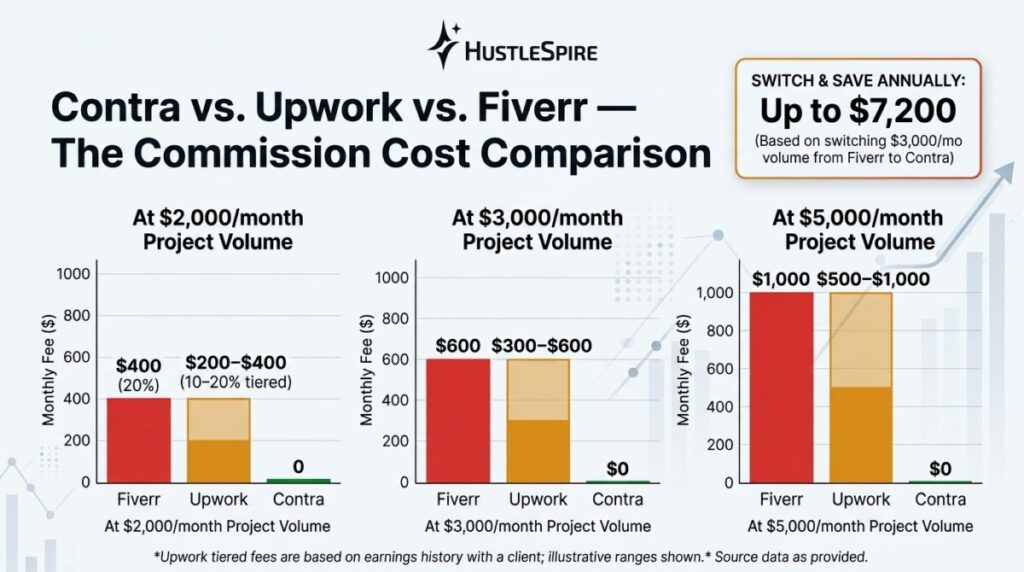
On a $2,000 project, Upwork’s 10–20% commission costs you $200–$400. Fiverr’s 20% costs you $400. Contra costs you $0. That’s a real, concrete number — not a theoretical advantage. For freelancers doing $3,000–$5,000/month in project volume, switching even a portion of that work to Contra saves $600–$2,000 annually in platform fees alone. The platform makes most financial sense for mid-to-higher volume freelancers, where fee savings compound meaningfully.

Step 3: Use Contra’s independent work features to bring existing clients onto the platform.
Contra allows you to invoice clients, manage contracts, and collect payments entirely within the platform — at zero commission — even for clients you found elsewhere. This is the overlooked feature that makes Contra immediately useful regardless of how much traffic the platform itself sends you. Freelancers who bring one or two existing direct clients onto Contra for payment processing eliminate the payment friction of personal invoicing while keeping 100% of their earnings. Pair it with a tool like Notion for project management and you have a lean, low-cost operations stack.
Step 4: Treat Contra as one platform in a multi-platform strategy, not a sole source.
Client volume on Contra is growing but remains lower than Upwork or Fiverr in most categories. The practical approach is using Contra for inbound leads and client payment processing while maintaining an active presence on higher-volume platforms for consistent work. Freelancers who go all-in on Contra exclusively before the platform reaches critical mass in their niche tend to experience income gaps. Use it as a commission-free layer in your existing workflow, not a complete pivot.
Contra’s Limitations in 2026
Contra is a younger platform, and younger platforms carry platform risk. If the business model shifts, client volume doesn’t grow, or the company pivots, your pipeline built there becomes unreliable. The client base, while high-quality in the tech and startup space, is narrower than Upwork’s sprawling marketplace. Additionally, dispute resolution and freelancer protection features on Contra are less developed than on established platforms — something to factor in before taking large projects through it exclusively. Zero commission is genuinely valuable, but it doesn’t replace the structural protections that more mature platforms offer.

Go to Contra and create a free profile today. Don’t copy your existing platform bio — write one specifically for a startup or tech-company audience. Add two or three of your strongest project samples, set your rate, and publish. Then identify one current client you invoice manually and send them your Contra payment link for the next project. That single switch starts saving you money immediately, with no new client acquisition required.
For creators who prefer selling digital products instead of freelance services, choosing the right platform becomes just as important as the work itself. A helpful comparison can be found in Sellfy vs. Gumroad vs. Stan Store: Which Platform Actually Pays You Faster?, which breaks down how different platforms handle payments and creator earnings.
