

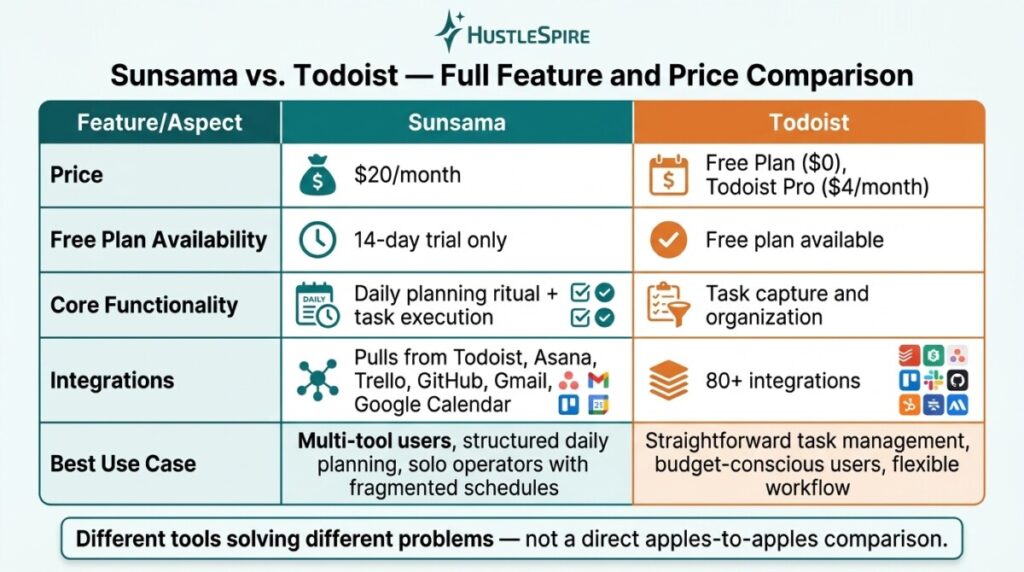
Todoist costs $4/month. Sunsama costs $20/month. On paper, that’s a straightforward decision in Todoist’s favor. In practice, the Sunsama vs. Todoist comparison isn’t really about price — it’s about what problem you’re actually trying to solve. Todoist is an excellent task manager. Sunsama is a daily planning tool built around the question most solo entrepreneurs struggle with: not “what do I need to do?” but “what am I actually doing today, and does it align with what matters this week?” Those are different products solving different problems.
What Most People Get Wrong When Comparing Productivity Tools
The mistake is evaluating tools by feature count rather than workflow fit. Todoist has more features, broader integrations, and a free plan that covers most basic task management needs. Sunsama has a narrower feature set, no free plan, and a 14-day trial before it asks for $20/month.
The relevant question isn’t which tool has more. It’s the tool that matches how you actually work. Solo side hustlers managing multiple income streams, client projects, and personal priorities across fragmented daily schedules tend to have a specific problem: they have long task lists and short, interrupted work windows. Todoist captures the list. Sunsama helps you work through it—one structured day at a time.
Sunsama vs. Todoist: What the $20/Month Actually Buys You
Sunsama’s daily planning ritual is the core feature that Todoist doesn’t offer.
Every day, Sunsama opens with a guided planning session — typically 10–15 minutes — where you pull tasks from integrated sources (Todoist, Asana, Trello, GitHub, Linear, email), time-block them against your actual available hours, and commit to a realistic day. It then tracks whether you completed what you planned and prompts a brief end-of-day review. That ritual — plan, execute, review — is what creates the behavioral loop that makes the tool worth the premium. Users who skip the daily planning session report the tool feeling expensive for what it delivers. Users who run it daily report that it pays for itself in focused output within the first week.

Todoist wins on capture, flexibility, and cost at scale.
Todoist’s Beginner plan is free forever and covers most individual task management needs. The Pro plan at $4/month adds reminders, filters, and labels. For someone whose primary need is capturing and organizing tasks across projects—without a structured daily planning workflow—Todoist is the more rational choice. It integrates with essentially everything, works across every device without friction, and has a decade of reliability behind it. There’s no shame in the cheaper tool when it genuinely fits your workflow better.
For freelancers juggling multiple clients and deadlines, having the right productivity system can dramatically improve how quickly they respond to opportunities. That’s exactly why The Upwork Profile Hack That Tripled My Response Rate (Copy This Framework) shows how small workflow improvements can lead to better results on freelance platforms.
The integration angle changes the calculation.
Where Sunsama earns its $20/month most clearly is when you’re pulling tasks from multiple tools simultaneously. A common pattern among active side hustlers: tasks in Todoist, client work in Asana or Trello, email commitments in Gmail, and calendar events in Google Calendar — all competing for the same limited daily hours. Sunsama pulls all of these into a single daily view and forces the prioritization decision. Todoist can’t consolidate across those sources the same way. If you work across three or more tools daily, that consolidation is where the premium justifies itself.
When neither tool is the right answer.
For side hustlers earlier in their journey — one income stream, straightforward task load, tight budget — neither Sunsama’s $20/month nor even Todoist’s paid tier may be necessary. A free Notion page or Apple Reminders handles basic task capture without overhead cost.
Sunsama’s Limitations Are Real
Sunsama has no free plan and no deeply discounted annual tier that makes the $20/month feel less significant. The 14-day trial is the only way to evaluate it without spending money. Additionally, the tool’s value is almost entirely behavioral — if you don’t run the daily planning ritual consistently, you’re paying for a calendar with nice integrations. Sunsama also has a smaller ecosystem than Todoist, and its mobile experience is less polished than its desktop version.

Start Sunsama’s 14-day free trial today and connect it to whatever task management or project tool you currently use. Run the daily planning session every morning for seven consecutive days — seriously, every morning. At day seven, compare your output and sense of daily clarity to the previous week. That comparison will tell you whether the $20/month is worth it for your specific workflow. If it isn’t, Todoist’s free plan is waiting, and there’s no cost to that conclusion either.
Many high performers rely on carefully chosen tools rather than trying to manage everything manually. In fact, The Secret Productivity Stack CEOs Use Instead of Hiring Assistants explores how the right combination of digital tools can replace hours of administrative work.
