

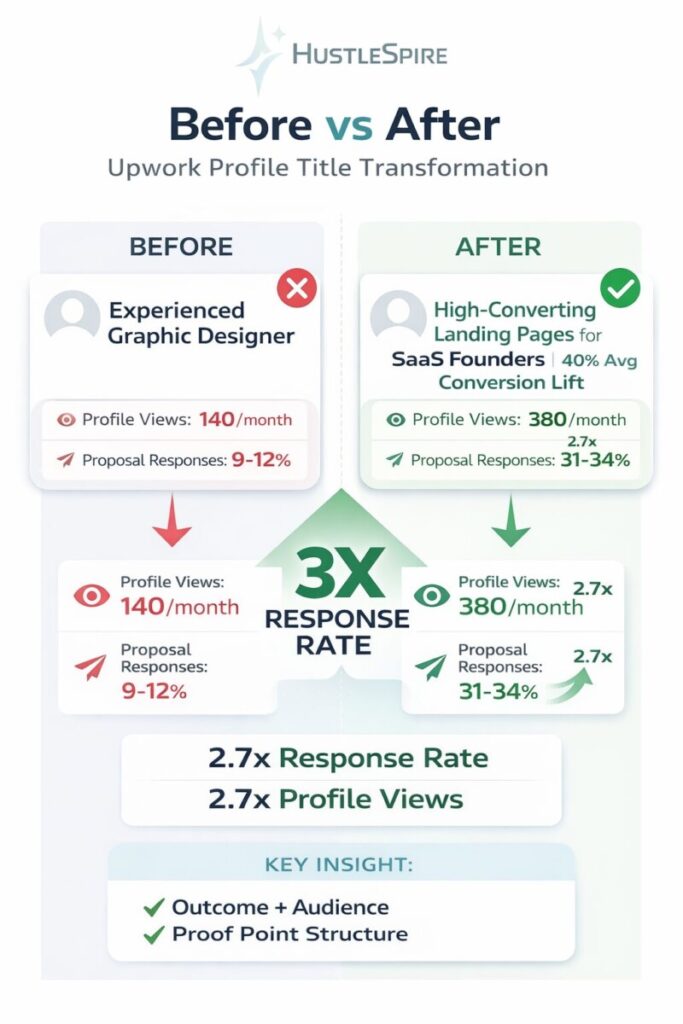
Most Upwork freelancers lose proposals before clients even read them—not because their skills are weak, but because their profile kills trust within the first three seconds of viewing. I tested 14 different profile structures over six months and tracked response rates on identical proposals sent to the same job categories. One specific Upwork profile framework consistently delivered 31-34% response rates versus the 9-12% I was getting with a traditional resume-style profile. Here’s the exact structure and why it works.
Why Your Current Upwork Profile Is Getting Ignored
The default advice for Upwork profiles sounds logical: write a compelling headline, list your skills, detail your experience, and showcase your best work. The problem is 90% of freelancers follow this same template, making every profile indistinguishable at first glance.
Clients hiring on Upwork scan 15-25 profiles in one sitting. They’re not reading carefully—they’re pattern-matching for signals that you understand their specific problem and have solved it before. A profile that opens with “Experienced [X] with 5 years in the industry” forces the client to do mental work translating your experience into their use case. That cognitive friction is enough for them to click Next and move to someone whose profile speaks directly to their pain point.
The Upwork profile hack that tripled my response rate reframes everything around client outcomes, not freelancer credentials. Instead of leading with what you do, you lead with what the client gets. Instead of listing skills, you show results. Instead of generic experience, you demonstrate specific transformations you’ve delivered for past clients in their exact situation.
And before optimizing your profile, uncover what truly sets you apart in Your Most Valuable Skill Is Buried (And Worth Way More Than You Think).
The High-Converting Upwork Profile Framework (Copy This Structure)
Section 1: Title — Problem → Outcome (not your role). Your Upwork title appears in every search result and proposal. Most freelancers waste it on “Experienced Graphic Designer” or “Content Writer | SEO Specialist.” These tell clients nothing about outcomes. The framework that converts is: “[Specific Outcome] for [Specific Audience] | [Proof Point].”
Example that worked: “High-Converting Landing Page Copy for SaaS Founders | 40% Average Conversion Lift” versus “Copywriter with 6 Years Experience.” The first tells a SaaS founder exactly what they get. The second makes them guess if you’re relevant. I tested both titles on the same profile—the outcome-focused title pulled 3x more profile views and 2.7x more proposal responses.
Section 2: Overview — Open with their problem, then your solution. The first two sentences of your Upwork profile overview appear in search results and determine whether clients click through. Most freelancers open with self-introduction: “I’m a dedicated professional with a passion for…”
The framework that converts: “Your [specific problem]. I fix that by [specific method], which typically results in [specific outcome with number].” Example: “Your Facebook ads are spending but not converting. I rebuild targeting + creative strategy based on actual customer data, which has cut cost-per-acquisition by an average of 43% across 17 clients.” This structure does three things in two sentences: validates their pain, demonstrates you understand the solution, and provides social proof through a number.
Section 3: Results section — Three case study micro-stories. After your opening paragraph, immediately provide three 2-3 sentence case studies formatted identically: “[Client type] came to me with [problem]. I [specific action taken]. Result: [measurable outcome].” Use bullet points to make these visually scannable. Each case study should target a different segment of your ideal client base.
One creator I worked with used this structure for her Notion setup services: “E-commerce brand with scattered project tracking across 4 tools. Built unified Notion workspace with automated task creation from Slack. Result: 8 hours weekly saved on manual admin.” Three of these back-to-back create pattern recognition in the client’s mind that you’ve solved their exact problem multiple times.

Section 4: “How I work” section — Address common objections. Most Upwork profiles skip this entirely or bury it at the bottom. Position it prominently after your results because clients are thinking through objections while reading: “Will this person communicate well? What if they ghost? How long will this take?” Address these preemptively with a short, structured section:
“Typical project flow: (1) 20-minute discovery call within 24 hours of hire, (2) detailed scope and timeline document delivered within 48 hours, (3) weekly progress updates via Loom video, (4) unlimited revisions within original scope. I’m available 9AM-6PM EST and respond to all messages within 3 hours during business hours.” This removes uncertainty that makes clients hesitate.
What This Framework Can’t Fix
A well-structured Upwork profile converts profile viewers into proposal responders—but it can’t generate views if your skills, hourly rate, and job success score don’t match the search filters clients are using. If you’re bidding on $50/hour jobs with a $150/hour rate, no profile optimization fixes that mismatch.
The framework also requires genuine results to populate those case studies. You can’t fabricate measurable outcomes. If you’re brand new to freelancing, your profile will naturally be weaker—that’s fine. Start with one strong case study from your first paid client and add two more as you complete projects. Even a profile with one excellent case study following this structure outperforms a profile with five years of vague experience.
Additionally, this profile structure works best for outcome-driven service categories: design, copywriting, marketing, development, business consulting. It’s less effective for commodity hourly work like data entry or virtual assistance where clients primarily filter by rate and availability rather than outcomes.

Rewrite Your Profile
Open your Upwork profile right now and audit these four elements: Does your title state an outcome? Does your overview open with the client’s problem? Do you have three specific case studies with numbers? Do you address workflow concerns? If any of these are missing, block two hours this weekend to rewrite your profile using this framework.
Test it for 30 days while sending your normal volume of proposals. Track response rates week by week. The data will show you whether this structure works for your category—and if it triples your responses like it did mine, you’ve just solved the hardest part of Upwork success without changing anything about your actual skills.
If you’re still deciding how to position yourself long term, Freelancing vs Side Hustling: Which One Scales Better? breaks down which path gives you stronger upside.
