

“I want to make $5,000 a month from my side hustle.” Sound familiar? That’s not a goal — it’s a wish. The revenue goal backwards method flips the process entirely. Instead of picking an income number and hoping your activity eventually matches it, you start with the number and reverse-engineer every daily action required to hit it. Most hustlers skip this step completely, which is exactly why 80% of side hustles stall below $500/month within the first year.
Why Vague Income Goals Keep You Stuck at Zero
Setting a revenue target without breaking it down is like punching an address into GPS but never hitting start. You know where you want to go — you have no idea how to get there.
The problem isn’t ambition. It’s that most people stop at the goal and never build the math behind it. “$5,000/month” tells you nothing about what to do on a Tuesday afternoon. It doesn’t tell you how many clients you need, what you need to charge, how many products you need to sell, or what your conversion rate has to be. Without that math, every day becomes guesswork — and guesswork produces inconsistent results at best.
Additionally, vague goals make it impossible to diagnose what’s actually broken when you’re not hitting your numbers.
How the Revenue Goal Backwards Method Actually Works
Step 1: Start with your net monthly target, not gross.
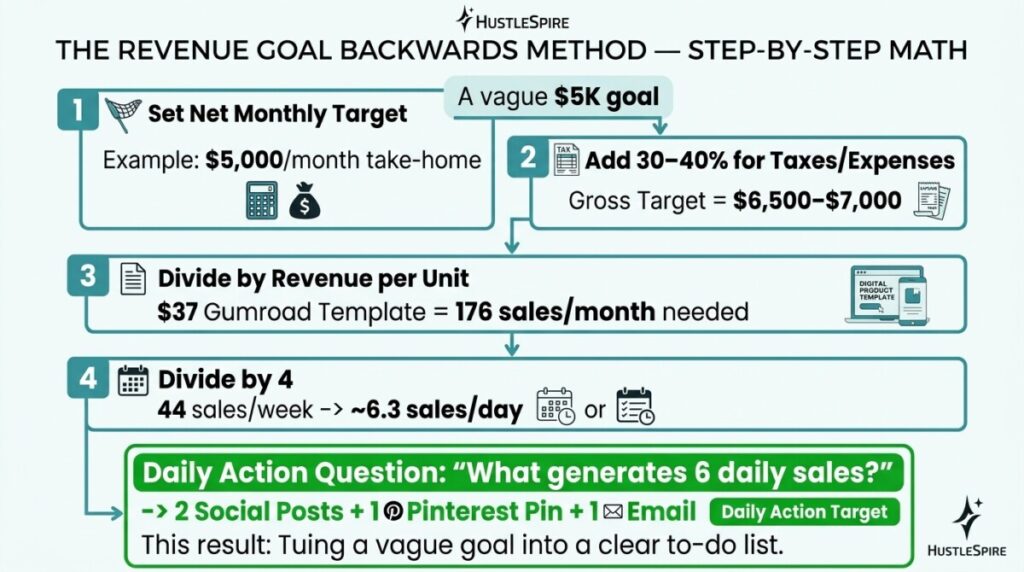
Most people set gross revenue goals and forget taxes, platform fees, and tool costs. If your side hustle goal is $5,000/month in take-home income, your gross revenue target is closer to $6,500–$7,000, depending on your tax bracket and expenses. This matters because every downstream calculation uses the wrong number if you start with the wrong number. Build your goal on what actually lands in your account.
Step 2: Identify your revenue-per-unit metric — and get specific.
This is where the reverse engineering starts. Divide your gross monthly target by your average revenue per transaction. A freelance writer charging $500/article needs 13–14 articles per month at $6,500 gross. A Redbubble seller averaging $4.50 per sale needs 1,444 sales, which immediately tells you that’s not a realistic single-platform strategy. A Notion template creator selling a $37 template on Gumroad needs 176 sales per month, or roughly 6 per day.
Those numbers force clarity. One hustler I know was trying to hit $3,000/month selling $9 digital stickers. The math required 333 sales/month — at a 2% conversion rate, that meant driving 16,650 monthly visitors to her store. When she saw that number, she immediately raised her prices. Problem solved in five minutes.
Before you can hit a financial target, you need a system that keeps your daily work simple and focused. That idea is explored in The 5-Minute Productivity System That Replaced My Entire Task Manager.

Step 3: Break your monthly unit target into weekly and daily actions.
176 monthly Gumroad sales = 44/week = ~6.3/day. Now the question shifts from “how do I make money?” to “what generates 6 daily sales?” That might mean 2 Instagram posts, 1 Pinterest pin, and one email to your list — every single day. When you track your side hustle income weekly and compare it to daily action metrics, you can see exactly which activity is driving conversions and which is a wasted effort.
Step 4: Build a 90-day ramp, not a day-one expectation.
Month 1 target: 30% of goal ($1,950 of a $6,500 target). Month 2: 60% ($3,900). Month 3: 100% ($6,500). This ramp acknowledges that audience building, SEO, and product–market fit take time. Tools like Notion or a simple spreadsheet work fine for tracking your ramp progress—the format doesn’t matter; the consistency does. If you’re using multiple income streams, consider a multi-stream side hustle planning template to keep each stream’s math separate and visible.
The Math Will Humble You — That’s the Point
The revenue goal backwards method isn’t motivating in the traditional sense. It often reveals that your current pricing is too low, your audience is too small, or your product–market fit needs work. That discomfort is data. Most hustlers avoid this exercise because the numbers are confronting. However, facing a hard math problem early beats grinding for six months before realizing your model doesn’t work.
Expect to revise your numbers at least twice in the first 90 days. Revenue per unit changes as you raise prices. Conversion rates improve as your content matures. The method is iterative — run the math monthly, not just once.

Do the Math
Open a Google Sheet or grab a piece of paper. Write your real monthly net income target. Add 30–40% for taxes and expenses to get your gross target. Divide by your average revenue per sale or per client. That’s your monthly unit target. Divide by 4 for your weekly number. Do that math today—before you post anything, pitch anyone, or build anything else. If the numbers don’t work on paper, they won’t work in practice. And if they do, you now have a daily action target instead of a wish.
Another powerful way to plan your goals is by focusing only on the work that produces the biggest results. This is explained in How to Apply the 80/20 Rule to Your Side Hustle (Make More, Work Less).
