

Most bloggers treat affiliate marketing like a vending machine—drop in content, pull out commissions. That’s not how it works, and it explains why the average affiliate blogger earns under $200/month while a small percentage earns $3,000–$10,000+. Affiliate marketing for bloggers in 2026 isn’t about slapping links into posts and hoping for clicks. It’s about building a deliberate multi-platform income strategy where your blog, your social channels, your email list, and your affiliate relationships all feed each other systematically. The bloggers who understand this are building compounding income. Everyone else is chasing one-off commissions.
Why Single-Platform Affiliate Strategies Keep Failing Bloggers
The most common mistake is treating the blog as the only distribution channel.
A blog post takes days to rank on Google. During those weeks and months, your affiliate links sit idle. Meanwhile, the same content—restructured for TikTok, repurposed for Pinterest, and condensed for a Telegram channel—starts driving clicks the same week you publish. Single-platform dependency also means a single algorithm change can wipe your income overnight. Google’s March 2024 core update deleted the traffic of hundreds of affiliate blogs that had zero social or email presence to fall back on. That lesson cost a lot of people their primary income source.
The bloggers rebuilding fastest after those kinds of disruptions are the ones who already had a TikTok content strategy driving affiliate traffic alongside their SEO work—not instead of it, alongside it.
How to Build a Multi-Platform Affiliate Income Strategy That Actually Compounds
1. Start with one affiliate program per content pillar, not ten.
The instinct when starting affiliate marketing for bloggers is to join every program available. Resist it. Each program you join creates management overhead—tracking dashboards, payout thresholds, link maintenance, and policy compliance. Instead, identify your blog’s 2–3 core content pillars and assign one primary affiliate program to each.
For a side hustle blog, that might be Fiverr for freelancing content, Canva for design and productivity content, and MailerLite for email marketing content. Each pillar has one affiliate relationship you understand deeply, promote authentically, and optimize over time. As each relationship matures and converts consistently, add a secondary program — never before.
2. Build content around buyer intent, not topic volume.
High search volume means nothing if the reader isn’t close to a purchase decision. “What is affiliate marketing?” gets searched 40,000 times per month. “Best Affiliate Programs for Beginner Bloggers” gets searched 3,000 times— and converts at five times the rate because the person already knows what they want and is choosing between options.
For every piece of affiliate content you publish, ask: Is this person 2 clicks from buying or 20 clicks from buying? Write primarily for the 2-click reader. Comparison posts, “best X for Y” roundups, and honest platform reviews (including downsides) are the formats that convert at the buyer-intent stage. This is why choosing the right Amazon Associates niche matters more than maximizing your content volume — specificity beats scale at the start.

3. Use your email list as the affiliate channel with the highest conversion rate.
Social media traffic converts at roughly 0.5–2% for affiliate offers. Email converts at 3–8% for the same offer to a warm list. That gap is enormous, and most bloggers ignore it by treating email as a newsletter afterthought rather than a structured affiliate channel.
Build at least one affiliate recommendation into every email sequence you run. Not a hard sell — a contextual mention. “I’ve been using MailerLite to run this newsletter—here’s exactly why I chose it over the alternatives” converts at multiples of a banner ad or a sidebar link. The reader already trusts you. That trust is your most valuable affiliate asset, and email is where it converts best.
4. Add a zero-gatekeeping platform like Benable to your affiliate stack.
Not every affiliate opportunity requires a blog post. Benable lets you create curated product recommendation lists with no follower minimum and no individual program approval process—then share those lists anywhere you already have attention. For bloggers, this means you can monetize your Pinterest traffic, your Telegram channel, and your TikTok bio link simultaneously with the same set of recommendations. It’s a low-overhead addition to an existing affiliate strategy that starts earning within weeks rather than months.
Multi-Platform Affiliate Income
Building across multiple platforms sounds like more work. In the first 60 days, it is.
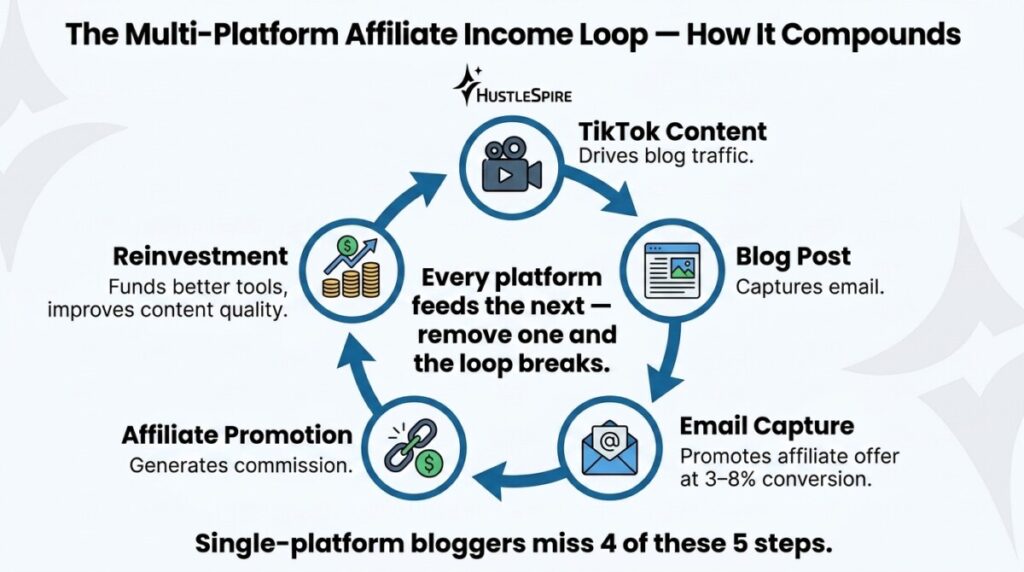
The payoff is that each platform starts feeding the others. A TikTok video drives people to your blog post, which captures their email, which promotes your affiliate offer, which earns a commission, which funds better tools, which improves your content. That loop doesn’t exist if you’re only on one platform. It also means that when one channel has a bad month — and every channel has bad months — the others carry the load.
Realistic income expectations for a focused multi-platform approach: $200–$500/month in the first 90 days, $800–$2,000/month by month 6–9 as content compounds across channels. These numbers assume consistent publishing, genuine affiliate relationships, and buyer-intent content as the foundation. If any of those three are missing, the timeline stretches significantly. Understanding this from the start — rather than discovering it at month four — is what separates bloggers who build something real from those who conclude that affiliate marketing as a side hustle “doesn’t work.”

This Week
Audit your current affiliate setup in 20 minutes. Count how many programs you’re in, how many have earned you anything in the past 90 days, and how many platforms you’re actively using to promote them. Most bloggers find they’re in 8 programs and actively using one channel.
Cut to your two best-converting programs. Pick a second channel — Pinterest, email, or TikTok — and commit to distributing your next three affiliate posts there this week. The strategy compounds only if you start building the second layer. Start it today.
