

Most digital entrepreneurs have more productivity tools than they have productive hours. Notion databases, ClickUp boards, color-coded Todoist projects — and yet the work still piles up. Here’s the uncomfortable truth: a 5-minute productivity system built around three daily priorities will outperform a complex task manager for most solo hustlers. Not because the tools are bad, but because complexity creates its own resistance. The more steps between you and starting, the less likely you are to start.
Why Your Task Manager Is Making You Less Productive
The problem isn’t organization — it’s optimization theater. You’re reorganizing your to-do list instead of working through it. One entrepreneur I know spent 45 minutes on a Sunday night building the perfect ClickUp workflow for his content business. By Wednesday, he’d abandoned it entirely and was back to a notes app. Sound familiar?
Most productivity advice assumes your biggest problem is tracking tasks. For side hustlers, the real problem is prioritization under constraint. You have two hours on a Tuesday evening. You don’t need a project management system. You need to know exactly what moves the needle tonight and nothing else.
And once you understand that, How to Apply the 80/20 Rule to Your Side Hustle (Make More, Work Less) becomes the obvious next step. It shows you how to focus only on the small actions that actually move the needle.
The 5-Minute Productivity System: How It Works in Practice
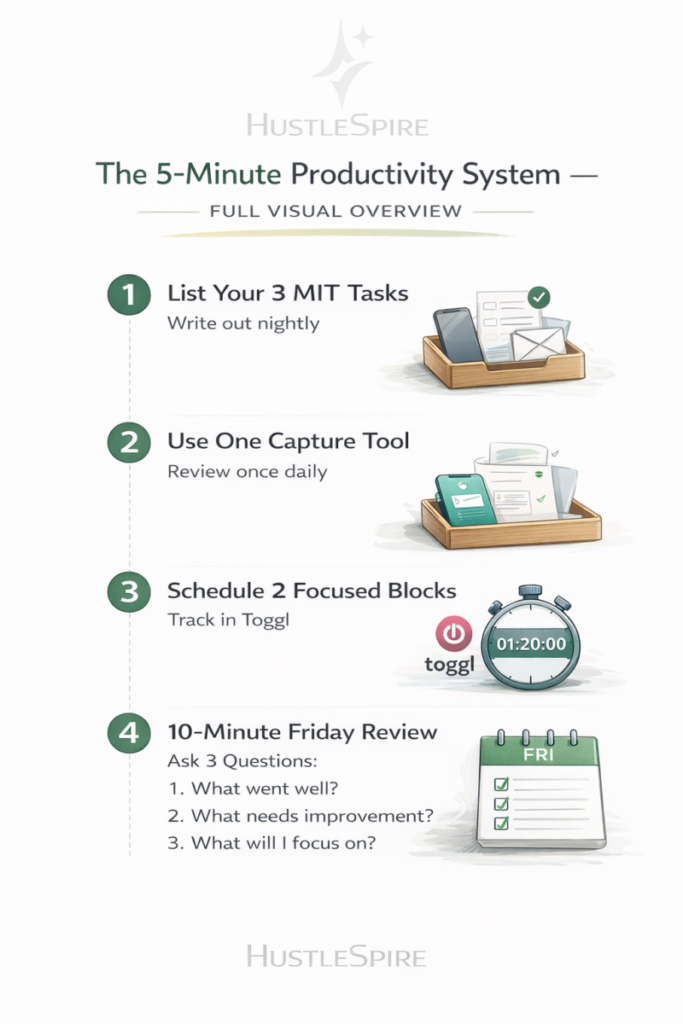
The entire system runs on one daily habit and one physical or digital surface. Here’s the structure:
Step 1: The 3-Task Rule — pick your MIT (Most Important Tasks) the night before.
Every evening, before you close your laptop, write down exactly three tasks for tomorrow. Not a brain dump. Not a full project list. Three specific, completable actions. For example: “Write intro section for blog post,” not “Work on blog.” The specificity removes the decision-making friction in the morning when your willpower is highest. Research on decision fatigue consistently shows that people make worse prioritization choices later in the day — so do it the night before when you’re still in work mode.
Step 2: Use a single capture tool — and stop switching between them.
Pick one place where every incoming idea, task, and obligation lands first. It can be Notion, a physical notebook, or even Apple Notes — the tool is not the point. The discipline of one inbox is. Most productivity breakdowns happen at the capture stage: a task lands in Slack, another in your email, another in your head, and suddenly nothing is anywhere. One capture tool, reviewed once daily, processed into your three-task shortlist.
Step 3: Time-block two focused sessions, not eight scattered ones.
Two 60-90 minute focused blocks beat eight 15-minute scattered attempts every time. Use Toggl Track (free) to log your sessions — not to monitor yourself, but to build an accurate picture of where your time actually goes. Most hustlers dramatically overestimate how many productive hours they’re working. Toggl data typically shows 2-3 genuinely focused hours per day, even for people who think they’re working 6+. Knowing your real number helps you schedule realistically instead of optimistically.
Step 4: Weekly review in under 10 minutes every Friday.
Every Friday, spend 10 minutes answering three questions: What did I finish this week? What carried over and why? What are the three most important things for next week? That’s it. No elaborate retrospective. No color-coded progress tracker. This single habit catches drift before it becomes a month of wasted momentum. Use a simple recurring Notion template or even a notes file you keep open all week.

Where This System Actually Breaks Down
This system works brilliantly for solo operators. It starts to strain when you’re collaborating with a team, managing client deliverables with hard deadlines, or running multiple income streams simultaneously. At that point, a lightweight project tool like Todoist (free plan covers most solo needs) or Trello becomes genuinely useful — not as your primary productivity system, but as a coordination layer on top of it. Additionally, the three-task rule requires honest prioritization. If you consistently choose easy tasks over important ones, the system will feel productive while your business stays flat.
Tonight, before you close your laptop, write three tasks for tomorrow on a sticky note or in your notes app. Just three. No categories, no priorities labels, no due dates. Wake up tomorrow and do the first one before you check email or social media. Run that experiment for five consecutive workdays and compare your output to last week. The data will make the argument better than any productivity book can.
What surprised me most wasn’t just the time I saved — it was how differently I started thinking about work. That shift is exactly what I break down in The Hustle Mindset: What Separates $1K Earners From $10K Earners — because productivity isn’t about doing more, it’s about thinking better
