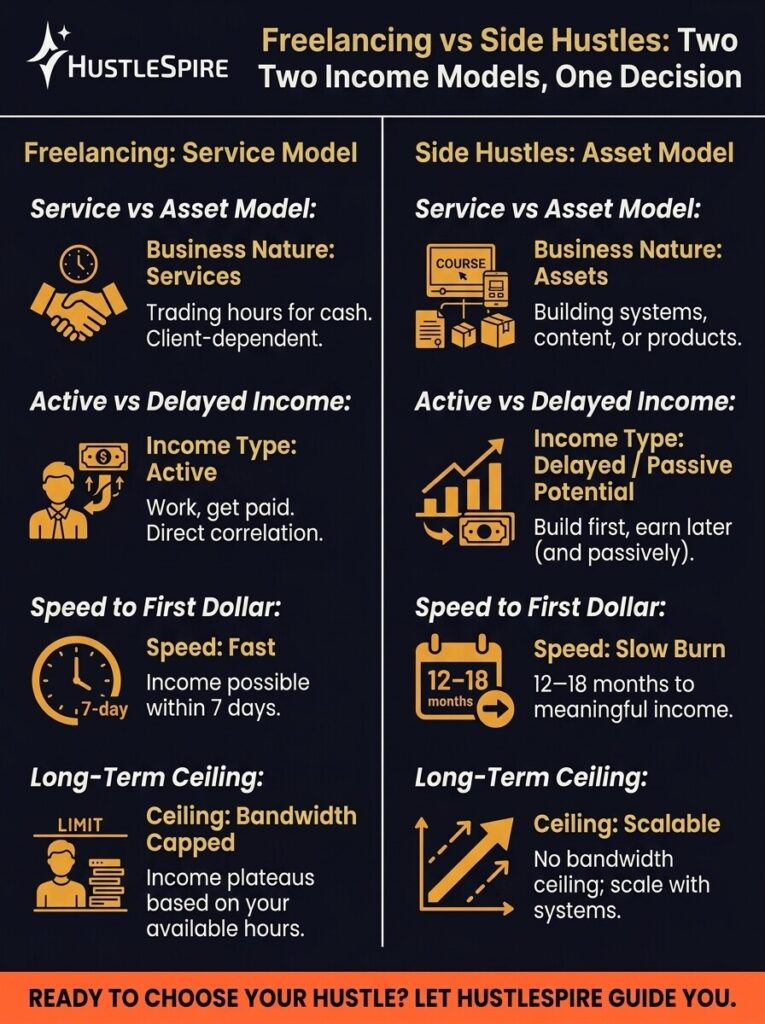
Freelancing vs side hustle – two popular ways to earn online, yet they follow very different paths. Freelancing focuses on client projects and skill-based work, while a side hustle grows into something you can own and scale. In this guide, we’ll break down which one truly offers more freedom and long-term growth.
Imagine this: you’re juggling your 9–5 but your mind is buzzing with ideas. Maybe you write, design, consult, or run an online shop after hours. You’ve heard about freelancing and side hustles, and now you wonder: which one really scales? Which can turn from a small gig into something big and sustainable? This post helps you decide by comparing both paths across multiple dimensions—growth potential, risks, flexibility, and even what it takes to make them scale. (Yes—you can scale a side hustle or a freelance career.)
Understanding the Basics
What Is a Freelance Career?
Freelancing means offering your skills (writing, design, development, marketing, etc.) to clients on a project or retainer basis. You work for yourself, pick your clients, and structure your time. It’s essentially a service business without a fixed employer.
What Counts as a Side Hustle?
A side hustle is any income-generating activity you do besides your main job. It could involve selling products, affiliate marketing, content creation, gig work, or even a small service you provide in off hours.
Overlap & Differences
Some freelancing is done as a side hustle, especially in the early stages.
But not all side hustles are freelancing—many are product or platform-based, passive, or semi-automated
Freelancing often demands more client interaction, while side hustles can lean more on automation or systems.
Which One Has More Scaling Potential?
Let’s examine the key factors that affect scalability.
1. Income Growth & Limits
Freelancers often hit a ceiling tied to how many hours or clients they can handle. You can raise your rates, but eventually, you reach a limit unless you add capacity—by hiring others or building a team.
Side hustles—especially those that rely on automation, digital products, or scalable systems—can sometimes break the linear “time for money” ceiling. For example, an online course or affiliate model can reach thousands of customers without adding more hours.
2. Flexibility vs Client Demands
Freelancing gives you control, but client deadlines, feedback loops, and scope creep can eat into your freedom. You’ll need solid boundaries and systems to stay balanced.
Side hustles (especially passive ones) are more forgiving. You decide when to work, pause, or scale. The trade-off is slower early growth that requires patience and consistency.
3. Risk, Consistency & Variability
Freelancers face unpredictable workloads and client loss—meaning fluctuating income.
Side hustles, meanwhile, may face algorithm changes, supply issues, or platform shifts. However, because they don’t depend on individual clients, the risks are more spread out.
4. Asset & Team Leverage
To scale, freelancers often need to build teams, subcontract tasks, or package high-value offers. That moves them from “doing the work” to “managing systems.”
Side hustles, on the other hand, can leverage automation, digital tools, and outsourcing more naturally—making it easier to scale once systems are set up.
Read also Making money with AI side hustles
5. Time & Investment Upfront
Freelancers in the freelancing vs side hustle journey often invest heavily in skill-building, portfolios, and client trust early on.
On the other hand, side hustles usually demand upfront work on systems, marketing, and content creation before results start to show. The front-end investment can feel heavier, but the long-term payoff often scales higher — especially when compared to traditional freelancing.
Comparison: Pros & Cons
Freelancing
Pros
- Quick to start earning (you can sell your skills immediately)
- High profit margins (you’re selling expertise)
- Clear deliverables and client relationships
- Can evolve into a full-time business
Cons
- Income tied to hours—hard to scale infinitely
- Inconsistent workload or client churn
- Ongoing need for client acquisition
- Little to no passive income without systemization
Side Hustling
Pros
- Potential for passive or semi-passive income
- Freedom to choose pace and timing
- Scalable through automation and digital systems
- Less dependent on clients
Cons
- Slower initial growth and returns
- Vulnerable to platform or algorithm changes
- Requires marketing, branding, and audience-building
- Takes patience and persistence to see results.
Signs That Your Side Hustle or Freelance Work Is Scalable
- You can automate or delegate recurring tasks.
- Revenue grows faster than your time investment.
- You’re outsourcing parts of your workflow (VA, design, fulfillment).
- You have repeat customers or passive income streams.
- Your growth no longer depends solely on your personal bandwidth.
Read more about How to validate your side hustle
From Side Hustle to Full Freelancer
Harlan Rappaport started as a side-hustle freelancer on Fiverr doing email marketing. Over time, he refined his offers, raised his rates, and scaled into a full-time freelance business generating over $800,000 in profit.
He transitioned from being the doer to being the manager of a team and systems—a strong example of how scaling really happens.
Must read: Making Your First $1,000 Online
Which Path Suits You Better?
There’s no single right answer. But here’s a guide:
- Do you enjoy client work and solving problems directly? → Freelancing may fit.
- Do you love systems, marketing, or product creation? → Side hustling might be better.
- Want faster cash flow? → Freelancing delivers quicker results.
- Looking for long-term freedom and passive income? → Side hustling scales better over time.
Check out the most underrated hustle nobody talks about
Combining Both
One of the smartest strategies in the freelancing vs side hustle journey is to start with freelancing to generate income and build credibility, while developing a side hustle in the background for long-term growth.
Over time, your side hustle can grow and even overtake your freelancing revenue. This hybrid approach gives you both stability and scalability.
Freelancing vs Side Hustle – Your Top Questions Answered
1. Can a freelance career become passive?
Yes, if you create systems, productized services, or build an agency. But total passivity is rare.
2. How long does it take for a side hustle to scale?
Anywhere from months to years, depending on effort, niche, and marketing consistency.
3. Which is better for financial stability?
Freelancing offers faster, more stable income early; side hustles win in long-term stability.
4. What skills help scale either path?
Sales, marketing, automation, delegation, and communication.
5. Can I switch from one to the other?
Absolutely. Many freelancers evolve into side hustlers—and vice versa—depending on goals.
6. Which requires less investment?
Freelancing typically needs only time and skill. Side hustles may need tech tools, ad spend, or inventory.
7. What are the biggest risks?
Freelancers risk losing clients; side hustlers risk platform changes or saturated markets.
8. What platforms can I use to start freelancing?
Fiverr – Best for beginners who want clients to find them through ready-made service gigs.
Upwork—Ideal for freelancers who prefer applying directly to projects and building long-term clients.
Freelancer – Combines both; you can bid for jobs or join contests to grow your experience.
All three help you turn your skills into income.
Core Insights
- Both freelancing and side hustling can scale—but differently.
- Freelancing scales through rates, team-building, or productized services.
- Side hustles scale through automation, digital assets, and systems.
- Side hustles tend to have more passive upside but slower early growth.
- A hybrid path that blends freelancing vs side hustle offers the best mix of steady cash flow and long-term growth potential.
Read also: Side hustles with $0 investment