

If you researched Toptal’s application process a year ago and bookmarked that tab for “when you’re ready,” that research is partially outdated.
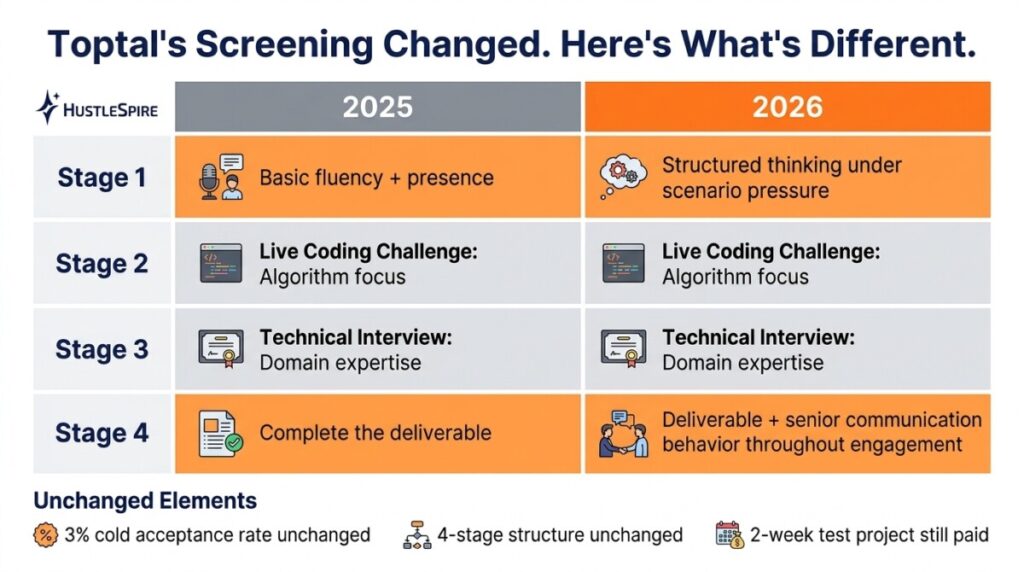
Toptal has adjusted how it screens candidates in 2026—tightening the communication evaluation, extending scrutiny of the test project phase, and placing greater weight on how applicants handle ambiguity under pressure. The core four-stage structure still stands. But what happens inside those stages has shifted in ways most guides haven’t caught up to yet.
Most applicants prepare for Toptal’s screening by practicing technical skills, which is necessary, but increasingly insufficient. The mistake is assuming the process screens primarily for what you know. In 2026, Toptal’s application process weighs how you think and communicate under real conditions just as heavily as domain competency. Candidates who over-index on technical prep and under-prepare for the communication and ambiguity layers are clearing Stage 1 and then stalling at Stage 3, where the live interview now probes deeper into reasoning and client readiness than in previous years.
What Changed in the Toptal Application Process in 2026
The first notable shift is in Stage 1 — the communication screening. Where the previous version assessed basic English fluency and professional presence, the 2026 version evaluates structured thinking under mild pressure. Screeners now present short scenarios and assess how applicants frame their response, not just whether they can respond clearly. The bar for passing Stage 1 has risen, and candidates who treat it as a formality are paying for that assumption at Stage 2.
The second shift is at the test project—Stage 4. The two-week engagement with a real client has always been the final filter, but in 2026, Toptal is placing greater emphasis on how accepted candidates communicate progress and flag blockers during that engagement. Completing the deliverable is no longer enough on its own. Screeners are evaluating whether the candidate operates like a senior professional or like someone executing a task. That distinction determines final acceptance.

What Has Not Changed — and Why That Still Matters
The four-stage structure remains intact: communication screen, timed technical or domain test, live interview, and a two-week paid test project. The 3% cold acceptance rate has not meaningfully shifted. And the referral advantage — where referred candidates pass at nearly five times the rate of cold applicants — remains one of the most underleveraged entry strategies available to serious candidates.
The timed technical test at Stage 2 still eliminates the majority of candidates who make it past Stage 1. The time cap is strict, the problem format is designed to expose preparation gaps, and there is no partial credit for good intentions. Candidates who practice under real constraints — timed, isolated, without reference materials — consistently outperform those who only review concepts without simulating the test environment.
How to Prepare for the 2026 Toptal Screening Specifically
Stage 1 preparation now requires more than professional polish. Practice explaining your decision-making process out loud—not just what you would do, but why and what tradeoffs you weighed. Record a two-minute answer to a scenario like “A client wants a feature built in a week that you know will create technical debt. How do you respond?” Your answer to that question, and how you structure it, is closer to what Stage 1 now evaluates than any resume review.
For Stage 2, use HackerRank or Codility to run timed drills in the two weeks before you apply. Set a timer. Close every reference tab. Simulate the pressure, not just the content. For Stage 3, prepare two or three case studies that demonstrate client-facing decision-making — not just what you built, but how you communicated tradeoffs to a non-technical stakeholder and what the measured outcome was.

The 2026 changes to Toptal’s screening make a strong application harder to fake and easier to build — if you prepare deliberately. The candidates who struggle are those who treat each stage as a separate event instead of a continuous signal Toptal is reading about how you operate. Every stage is evaluating the same underlying question: does this person function like a senior independent professional, or are they a skilled technician who still needs management? Your preparation should answer that question at every stage, not just the technical one.
Before you open the Toptal application form, run one specific self-audit: record yourself answering a client scenario out loud, without notes, in under two minutes. If the answer is clear, structured, and demonstrates a tradeoff you consciously weighed—you’re Stage 1 ready. If it isn’t, that gap is more urgent to close than any additional technical prep. Fix the communication layer first. The technical test will still be there when you’re ready for both.
