

Toptal’s rejection email is exactly two sentences. No stage breakdown, no specific feedback, no indication of where you failed.
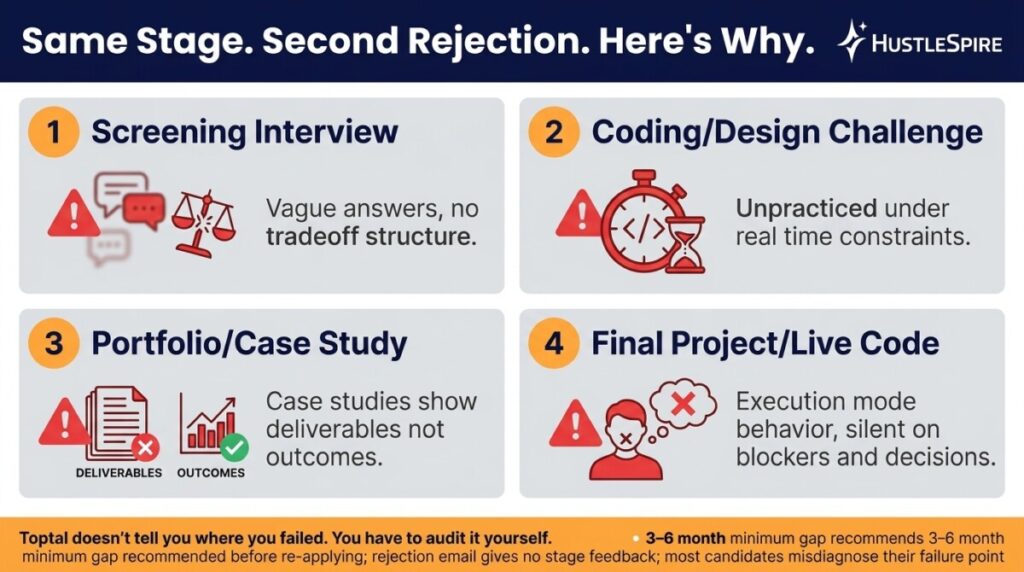
Most rejected candidates spend weeks assuming it was a technical gap—so they study harder, sharpen their code, and reapply with the same structural weaknesses that eliminated them the first time. The second Toptal application fails for the same reason the first one did: not because the candidate didn’t improve, but because they improved the wrong things.
Failed candidates assume Toptal rejected them for what they couldn’t do. The more accurate diagnosis is that Toptal rejected them for how they showed up—how they communicated under pressure, how they structured ambiguous answers, and how they handled the test project as a professional rather than a task executor. Doubling down on technical prep after a rejection without auditing the communication and judgment layers is the most common and most expensive mistake in a second Toptal application. It produces a better-skilled candidate with the same fatal presentation gap.
The First Thing Failed Candidates Get Wrong on Their Second Toptal Application
They reapply too soon. Toptal tracks application history, and returning too quickly — without a meaningfully different profile and demonstrably stronger preparation — signals exactly the kind of low self-awareness the platform screens against at Stage 1. The minimum gap most successful re-applicants observed before their passing attempt was three to six months. That timeline isn’t arbitrary. It reflects how long it actually takes to rebuild the communication and case study infrastructure that Stage 3 and Stage 4 evaluate.
The second mistake is treating the rejection as a single-point failure. Toptal’s process has four stages, and a rejection at Stage 2 requires different remediation than a rejection at Stage 4. If you cleared the communication screen but failed the timed technical test, the fix is targeted and measurable — two weeks of constrained timed drills on HackerRank or Codility. If you passed the technical test and failed the live interview, the fix is structural: rebuilding how you frame decisions and communicate tradeoffs under real-time pressure with no prep window.
What Successful Second-Time Toptal Applicants Changed
The single most common fix among candidates who passed on their second attempt was not technical — it was the case study portfolio. First-time applicants typically show deliverables: “I built X.” Passing second-timers showed outcomes: “I built X, which reduced Y by Z percent, and here is how I communicated that tradeoff to the client when scope shifted mid-project.” That specific structure — contribution, outcome, client communication under pressure — is exactly what Stage 3 interviewers probe for.

The second consistent change was in how they approached the two-week test project at Stage 4. First-attempt candidates operated in execution mode — heads down, focused on output quality. Second-attempt candidates who passed operated in senior professional mode—proactively updating the client on progress, flagging blockers before they became delays, and delivering a brief written summary of the decisions made during the engagement. The deliverable was identical in quality. The behavior surrounding it was not.
How to Rebuild Your Toptal Profile Before Re-Applying in 2026
Start with an honest stage-by-stage audit. Write down which stage you believe you failed and what evidence supports that conclusion — not what you hope the answer is. Then treat each stage as a separate sprint. Stage 2 prep is a two-week timed drilling discipline. Stage 3 prep is building three case studies that follow the contribution-outcome-communication structure. Stage 4 prep is practicing senior communication habits on any current freelance engagement you have access to right now before you re-enter the Toptal funnel.
A referral on your second attempt is not optional — it is the highest-leverage move available to you. Referred candidates pass at nearly five times the rate of cold applicants, and arriving with a referral on a second attempt resets the trust signal attached to your name more effectively than any amount of solo preparation.
A second Toptal application that fails the same stage as the first one is not bad luck. It is a preparation audit failure. The candidates who pass on their second attempt are not necessarily more talented than those who don’t—they are more honest about what actually eliminated them and more deliberate about fixing it specifically. That requires sitting with uncomfortable feedback about communication and judgment, not just logging more hours on LeetCode. Most people won’t do that work. That is precisely why the acceptance rate stays at 3%.

Today’s action is a stage audit, not a study session. Open a blank document and write one sentence for each Toptal stage: what you did to prepare for it before your first application, and what specific evidence suggests it was or wasn’t the stage where you failed. That document is the foundation of your second attempt. Without it, you are guessing. With it, you have a targeted remediation plan—which is the only kind that actually changes the outcome.
