

Most freelancers price their services based on what feels fair to them — then wonder why clients push back, ghost, or ask for discounts. The issue isn’t the number. It’s the structure around the number. Pricing psychology isn’t manipulation — it’s understanding how clients mentally process value before they decide. Applied correctly, these principles reduce negotiation, improve close rates, and position you as the confident choice rather than the cheapest available option. The freelancers who rarely negotiate aren’t necessarily more talented. They’re better at presenting prices.
What Freelancers Get Wrong About Why Clients Negotiate
The common assumption is that negotiation happens because the price is too high. Often, it happens because the value isn’t clear. A client who understands exactly what they’re getting, why it costs what it costs, and what outcome they can expect rarely pushes back on price. A client staring at a single number with no context almost always does.
Pricing psychology works at the presentation layer — before the client ever responds. It’s the difference between sending “my rate is $1,500” and sending a structured proposal where $1,500 is the obvious right choice among clearly defined options. The second version closes faster, negotiates less, and attracts clients who respect your work rather than those trying to minimize their spend.
For many freelancers, the easiest place to apply pricing psychology is in service-based work where conversations with clients happen directly. That’s one of the key ideas behind Why Your First $1,000 Should Come From Services, Not Products, which explains why services are often the fastest way to start generating real income.
Pricing Psychology Principles That Actually Reduce Negotiation
Principle 1: Use tiered pricing to make your target price the middle option.
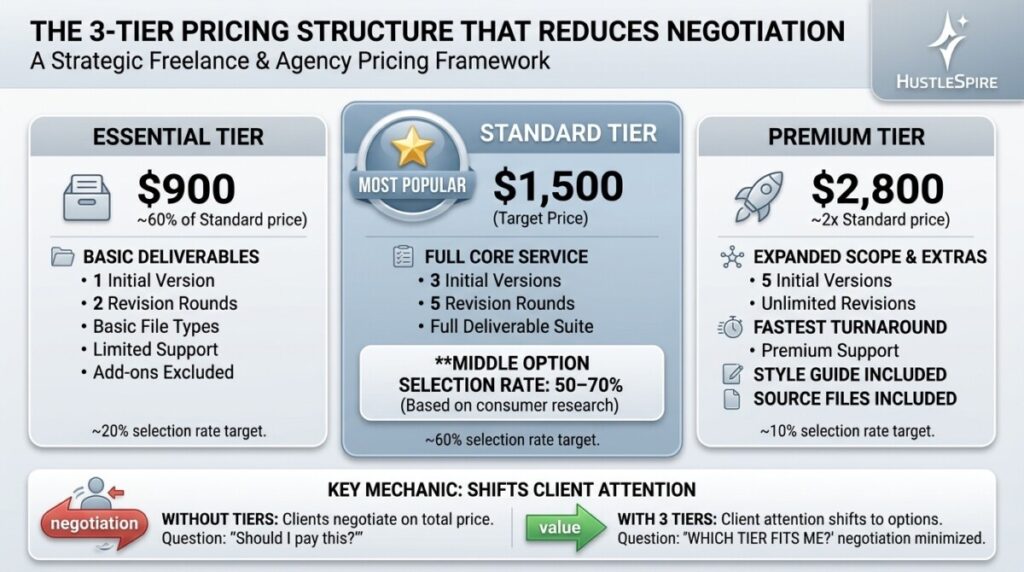
Presenting three service tiers — Essential, Standard, and Premium — reliably shifts client attention from “should I pay this?” to “which tier fits me?” The middle tier becomes the default choice for most clients because it avoids the perceived risk of the cheapest option while not overcommitting to the most expensive. Price your actual target service as the Standard tier. Research on consumer behavior consistently shows that middle-option selection rates run 50–70% across industries when tiers are clearly differentiated. For freelancers on Fiverr or building independent proposals, three-tier packaging is one of the highest-impact presentation changes you can make.
Principle 2: Anchor with a premium number first.
When a client sees your Premium tier at $3,500 before seeing your Standard at $1,500, the $1,500 feels reasonable by comparison. When they see $1,500 first with no context, it becomes the anchor itself — and every negotiation pulls it down from there. Lead your proposals with the highest tier, even if you expect most clients to choose the middle. The anchoring effect is well-documented in pricing research: the first number a buyer sees disproportionately shapes their perception of what’s fair.
Principle 3: Replace hourly rates with outcome-based pricing.
Hourly pricing triggers a mental audit. Clients start calculating how many hours your work should take and whether your rate is justified. Outcome-based pricing removes that audit entirely. Instead of “$85/hour for copywriting,” the proposal reads “$950 for a five-email welcome sequence that converts new subscribers into buyers.” The deliverable and the outcome are clear. The hourly math is irrelevant. Freelancers who make this shift consistently report fewer negotiation attempts and higher average project values.
Principle 4: Add a specific, low-cost add-on to your Standard tier.
Offering a $150–$200 add-on alongside your Standard package does two things: it gives the client a sense of control over their spend, and it increases your average project value without requiring a new sale. For example: “Standard package at $1,500 — add a 30-minute strategy call for $150.” Many clients who would never upgrade to Premium will add a small, specific enhancement. This pattern works reliably on project-based platforms and in direct proposals alike.

Pricing Psychology Has Limits
These principles work best when your service quality supports the price you’re presenting. Tiered pricing and anchoring improve how clients perceive your rates — they don’t compensate for a weak portfolio or unclear positioning. Additionally, pricing psychology is most effective in written proposals and structured service pages. In live conversations, clients can ask direct questions that require confident, specific answers about your process and outcomes. If you can’t articulate why your Standard tier costs what it costs, the presentation structure won’t save the conversation.
Take one service you currently offer with a single flat rate and restructure it into three tiers before your next client conversation. Use Notion or HoneyBook to build a simple one-page proposal template with Essential, Standard, and Premium clearly defined. Price your target package as Standard, set Premium at roughly 2x, and Essential at roughly 60%. Send it to the next prospect who asks for your rates and track whether the conversation changes.
Interestingly, the best pricing strategies rarely come from working harder or pushing clients aggressively. In fact, Why Successful Side Hustlers Never Work Hard (They Do This Instead) explores how smart positioning and strategic thinking often outperform pure hustle.
