

Companies pay real money — typically $10–$60 per test — to watch regular people use their websites and apps. Not UX researchers. Not tech professionals. Regular people who can navigate a site and talk through what they’re thinking. The user testing side hustle requires no portfolio, no pitching, no specialized skills, and no equipment beyond a laptop and a microphone. Yet most people either don’t know it exists or assume the pay is too low to bother with. The pay isn’t low. The availability is the actual constraint.
What People Get Wrong About Paid User Testing
The common misconception is that user testing platforms are survey sites with a fancier name. They’re not. Platforms like UserTesting, Userlytics, and TryMyUI pay testers to complete specific tasks on websites or apps while speaking their observations aloud — a method called think-aloud testing. The output is a recorded session that the client’s product team watches to identify usability problems.
The work is more engaging than surveys, pays significantly better, and takes 15–30 minutes per test rather than hours. The challenge isn’t the work itself — it’s test availability, which varies by platform and tester profile. Understanding how to maximize your availability across multiple platforms is where the real income strategy lives.
Interestingly, many user testers discover that reviewing websites sharpens their own workflow and organization habits. That’s exactly the idea behind The 5-Minute Productivity System That Replaced My Entire Task Manager, a simple method for staying organized without complicated productivity apps.
How to Build a Consistent User Testing Income Stream
Step 1: Sign up across multiple platforms simultaneously — not just one.
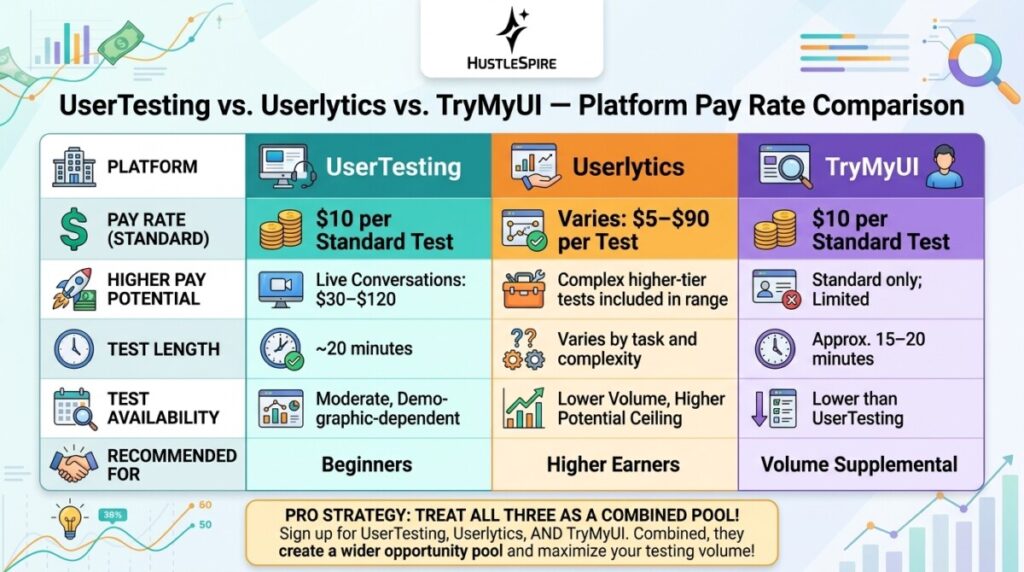
UserTesting is the most well-known platform and pays $10 per 20-minute test for standard tests, with live conversation tests paying $30–$120 depending on length and client. However, relying on UserTesting alone limits your volume significantly, as tests are distributed by demographic match and availability varies week to week. Userlytics pays $5–$90 per test depending on complexity. TryMyUI pays $10 per test. Signing up for three or four platforms and treating them as a combined pool dramatically increases how often you’re matched with available tests.
Step 2: Complete your screener profile thoroughly and honestly.
Every platform uses screener profiles to match testers with relevant studies. A complete profile — age, occupation, income range, device ownership, software familiarity, shopping habits — gets matched to more tests than a sparse one. Don’t exaggerate your profile to qualify for more tests. Clients verify tester profiles against behavior, and accounts flagged for inconsistency get deactivated. A thorough, accurate profile compounds over time because platforms prioritize testers with clean records and high completion rates.

Step 3: Treat your verbal delivery as a skill worth developing.
The quality metric platforms use to rate testers is almost entirely based on think-aloud quality — how consistently and clearly you narrate your actions and reactions while completing tasks. Testers who narrate continuously (“I’m looking for the checkout button, I’d expect it to be in the top right corner but I’m not finding it there…”) consistently receive higher ratings than those who go quiet while navigating. Higher ratings directly affect how frequently you receive test invitations on most platforms. A 15-minute practice session narrating your way through any website builds this muscle quickly.
Step 4: Apply for live conversation studies when available.
Live tests — where you interact directly with a researcher via video call — pay $30–$60 for 30–60 minutes on UserTesting, and up to $120 for longer enterprise sessions. These require the same think-aloud skills but reward them more generously. Live slots fill fast, so checking your platform dashboard or email notifications daily during business hours gives you the best access.
What the Income Actually Looks Like Week to Week
User testing is genuinely not a replacement income. Most active testers across three or four platforms earn $100–$300/month, with highly active testers in desirable demographics (tech-adjacent, specific age ranges, niche software users) occasionally hitting $400–$600/month. Test availability is unpredictable — some weeks bring five opportunities, some bring none. The income also depends heavily on your demographic match with client needs, which you can’t fully control. This side hustle works best as a supplemental stream alongside other income rather than as a standalone earner.

Create accounts on UserTesting and Userlytics today — both are free to join and take under 10 minutes to set up. Complete your screener profiles fully on both platforms before you close your laptop. Then do one practice run: open any website, set a five-minute timer, and narrate everything you observe and think aloud. That single exercise will tell you immediately whether this income stream fits your communication style.
User testing isn’t the only simple way people are turning everyday tools into income. In fact, The Notion Template Side Hustle: $2K/Month Selling What You Already Built explains how some creators are making money simply by selling productivity systems they already designed for themselves.
