

Most people building Notion systems for their own productivity never realize they’re sitting on sellable products. That content calendar you built to organize your blog? Someone will pay $12 for it. The client tracker managing your freelance work? Worth $19 to other freelancers. The Notion template side hustle works because you’re not creating from scratch—you’re packaging systems you already use and trust, which means zero product development risk and immediate market validation from your own workflow.
Why Most Notion Template Sellers Stay Stuck Under $100/Month
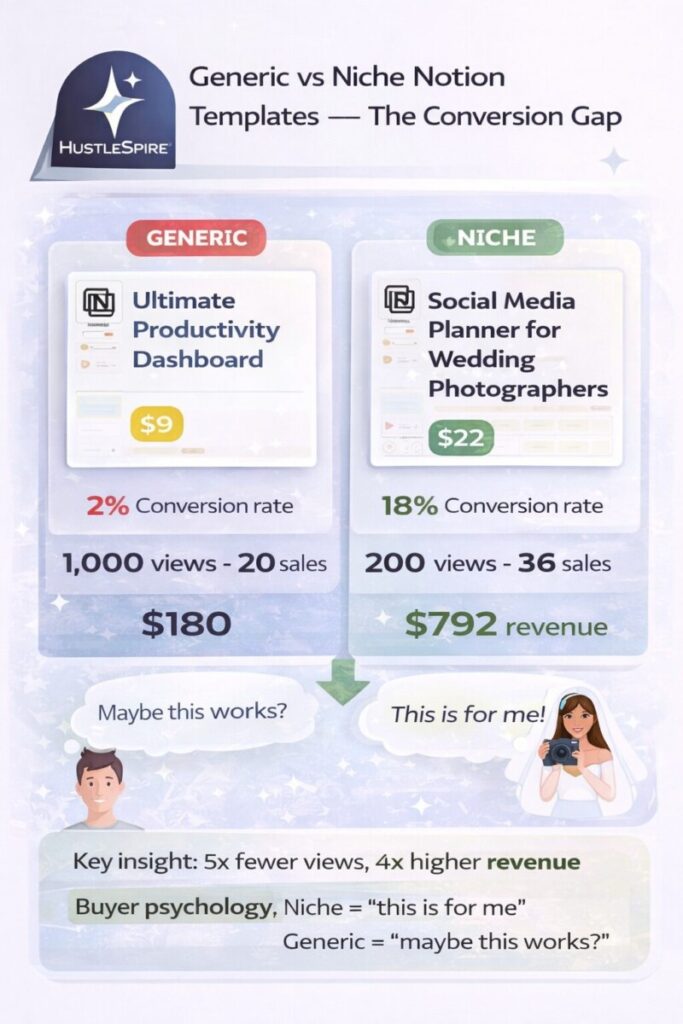
The mistake is treating templates like passive income. You build one generic productivity dashboard, list it on Gumroad for $9, and wait for sales that never come. The market isn’t looking for another “Ultimate Productivity System”—it’s saturated with those.
What sells consistently are hyper-specific templates solving narrow problems for defined audiences. A “Social Media Content Planner for Wedding Photographers” outsells a generic “Content Calendar” by 10x because the buyer immediately sees themselves in the product. Specificity reduces perceived risk and increases perceived value simultaneously.
The second mistake is underpricing. Templates priced at $5-7 signal low quality and attract tire-kickers who leave bad reviews over minor issues. Templates at $15-29 attract serious buyers who actually implement them and leave thoughtful feedback. One seller I know raised her price from $7 to $22 and saw conversion rates stay flat while revenue tripled—proving the market values quality positioning over bargain pricing in the Notion template side hustle space.
How to Build and Sell Notion Templates That Hit $2K Monthly
Step 1: Identify three workflow systems you already use daily. Don’t invent templates for hypothetical markets—clone what’s working in your life right now. Your client invoicing system, your project pipeline tracker, your content idea database, your meal planning setup. If you’ve used it for 30+ days and it solves a specific recurring problem, it’s a candidate for productization.
The best templates come from friction points you’ve already solved. If you spent two hours figuring out how to track multiple client projects with different deliverables and deadlines, other freelancers in your niche face that exact problem. Your solution has market value—not because it’s revolutionary, but because it’s battle-tested and saves the buyer those two hours plus ongoing organizational headaches.
Step 2: Package three related templates as tiered products. Don’t sell just one template—build a product line. A basic version at $12-15, a pro version with additional databases or automation at $22-29, and a bundle with complementary templates at $45-59. This pricing structure gives buyers options and immediately positions you above bargain sellers.
One creator built a Notion template side hustle around real estate agent workflows: a basic client tracker ($15), a pro version with transaction milestones and commission calculator ($27), and a complete agency bundle with team dashboards ($55). She launched all three simultaneously in March 2026 and hit $1,400 in the first month—then $1,900-$2,200 monthly by month three as organic search and word-of-mouth compounded.

Step 3: Sell on Gumroad, not Notion’s marketplace. Gumroad takes 10% versus Notion’s marketplace taking a significantly larger cut, and more importantly, Gumroad gives you the customer email list for future product launches and updates. Build your Gumroad page with clear before/after visuals, a short Loom video walkthrough (2-3 minutes max), and 3-5 specific use cases showing exactly who benefits.
Step 4: Distribute through niche communities, not broad social. Your $27 CRM template for wedding photographers won’t gain traction on general Twitter. It will sell when you share it in three active Facebook groups where wedding photographers ask organizational questions, or when you answer a specific workflow question on Reddit’s wedding photography subreddit and mention your template as the solution you built.
Target 5-10 hyper-relevant communities where your ideal buyer already congregates. One helpful answer with a natural template converts better than 50 generic social posts to followers who aren’t your market.
If you’re overlooking high-income digital roles, The Side Hustle Everyone Scrolls Past: How Community Managers Quietly Make $10K+ Monthly shows how simple skills can turn into serious recurring revenue.
What Kills Notion Template Income
Templates require ongoing maintenance. Notion updates features, changes database structures, or deprecates functionality—breaking templates without warning. Budget 2-3 hours monthly to test your products, update broken elements, and respond to buyer questions. Sellers who ghost after the sale get destroyed in reviews and refund requests.
Competition in popular niches is genuinely high. “Productivity dashboards” and “habit trackers” are flooded. Your edge is specificity—but if your niche is too narrow, total addressable market caps your ceiling at $300-500 monthly regardless of quality. The sweet spot is a niche large enough to sustain $2K monthly (10,000+ potential buyers) but specific enough to reduce direct competition.
Additionally, expect 30-60 days before consistent sales momentum builds. Month one might generate $200-400 as you test distribution channels and gather initial reviews. Month two typically sees $600-900 as organic search starts working and early buyers leave feedback. Month three is when $1,500-$2,500 becomes realistic if you’ve built in a profitable niche with strong distribution.

Clone One System You Use
Pick one Notion system you’ve been using daily for at least a month. Duplicate it into a clean version, remove all your personal data, add brief instructional text explaining each database and view, record a 3-minute Loom walkthrough, and list it on Gumroad at $17-22 before Friday.
Don’t wait for it to be perfect. Your first template teaches you what buyers actually need versus what you think they need. Launch, learn from the first five sales, iterate based on feedback. That’s how you turn the Notion systems you’re already maintaining into the $2K monthly income others are quietly earning.
And if you’re rethinking how you spend your free time, Why Your Weekends Are Worth More Than You Think explains how small focused hours can compound into income streams like selling Notion templates
