

If you’ve ever looked into becoming a Skillshare instructor, you probably walked away confused about how the money actually works. No per-sale price. No fixed royalty rate. Just a royalty pool — and that phrase alone makes most people assume the earnings are tiny. They’re not always. Skillshare instructors collectively earn millions annually through this model, and understanding how it actually functions is the first step to making it work for you.
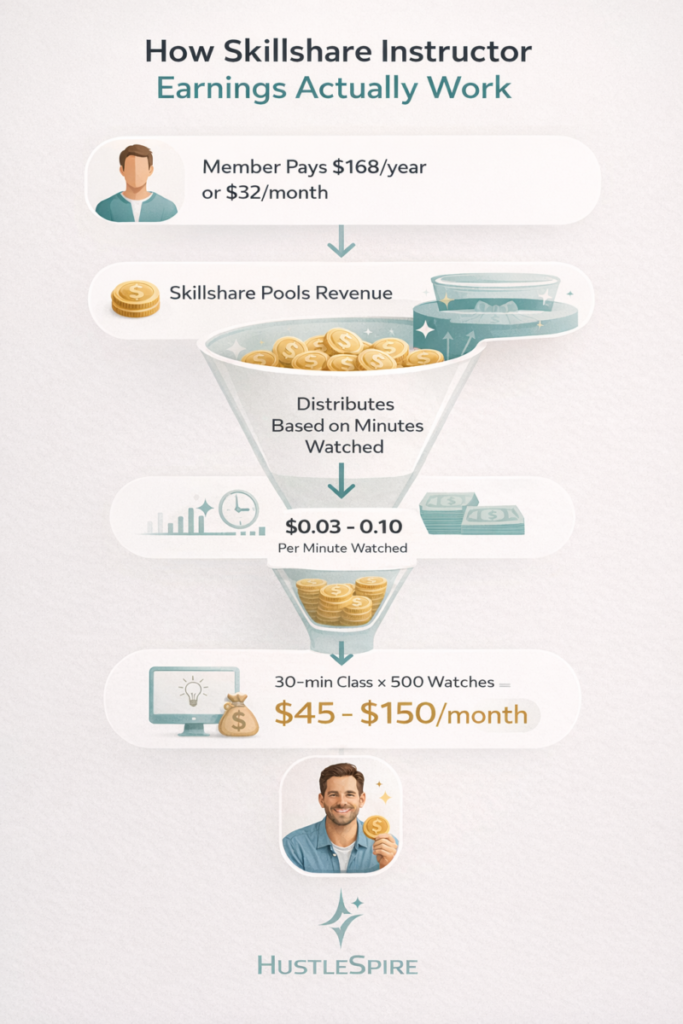
The platform operates on a subscription model — members pay around $168/year or $32/month — and Skillshare distributes a portion of that revenue to instructors based on minutes watched. You earn a share of the pool proportional to how much of the total platform watch time your classes generate. So the real income variable isn’t your course price. It’s your watchtime.
What Most Aspiring Skillshare Instructors Get Wrong
Most people assume teaching on Skillshare means recording one long, comprehensive course and waiting for passive income to roll in. That thinking produces mediocre results. Skillshare’s audience skews toward short, project-based classes — the sweet spot is 20-60 minutes total, broken into lessons of 3-7 minutes each. One instructor I’ve seen build a solid side income on the platform has 14 classes, none longer than 45 minutes, all focused on narrow, specific skills in the graphic design space.
Broad topics lose. Specific topics win. “Freelance Writing” is a category. “Writing Cold Emails That Actually Get Responses” is a Skillshare class.
If you’re beginning to see that teaching online is more powerful than it looks, you’ll probably enjoy The $1,000/Month Side Hustle Hiding in Your Brain: Online Tutoring’s Dirty Little Secret — it breaks down how the knowledge you already have can quietly turn into consistent income.
How to Become a Skillshare Instructor and Build Real Earnings
Step 1: Choose a topic with existing demand, not just personal passion.
Before you record anything, search Skillshare directly for your topic area. If you see 50+ classes on a subject, that’s not a red flag — that’s proof of demand. Your job is to find the angle those classes don’t cover, or cover poorly. Skillshare’s instructor page lets you apply for free. There’s no approval gatekeeping like Udemy’s course review process — you can publish and iterate quickly.
Step 2: Treat your first class as a trailer, not a masterpiece.
Your first class exists to establish your presence on the platform and start accumulating watchtime. Aim for 20-30 minutes across 5-8 lessons. Use Loom for free screen recording if you’re teaching a software skill, or a basic smartphone setup if you’re teaching something hands-on. The production bar on Skillshare is genuinely lower than YouTube — clear audio matters far more than camera quality.
Step 3: Understand the royalty pool math before you get discouraged.
Skillshare doesn’t publish exact per-minute rates, but estimates from active instructors suggest somewhere between $0.03 and $0.10 per minute watched, depending on the pool size that month. That means a 30-minute class watched 500 times in a month could generate $45-$150. That’s one class. Instructors with 10-15 focused classes, each generating modest but consistent watchtime, can realistically earn $500-$2,000/month. It scales through volume and catalog depth, not individual course virality.
Step 4: Promote outside the platform to accelerate growth.
Skillshare does surface your classes to existing members, but external traffic multiplies your results. Share class links in relevant Reddit communities, repurpose short clips for YouTube or TikTok, and build an email list from day one using a free tool like Mailchimp. Instructors who treat Skillshare as a standalone passive income source grow slowly. Those who funnel outside traffic into it grow fast.

Timeline and Platform Limitations
Reaching your first $100/month on Skillshare typically takes 2-4 months if you publish consistently and promote actively. Hitting $500/month usually requires 8-12 well-positioned classes and an audience you’ve built partially outside the platform. The royalty pool also fluctuates — your earnings in December might look different from March with no changes on your end. That volatility is real, and it’s worth comparing Skillshare to Teachable or Udemy if you want more pricing control over your courses.
Go to Skillshare’s teach page today and browse the top classes in your area of expertise. Identify one narrow topic — something you could cover thoroughly in 25 minutes — that has demand but no clear standout class. Outline five lessons around it this week. You don’t need a studio or a production budget. You need a specific topic, clear audio, and the discipline to actually hit publish.
If your bigger goal is long-term leverage, not just quick cash, read How to Build a Passive Income Stream from Scratch. It connects the dots between creating once and earning repeatedly — which is exactly why platforms like Skillshare can be so powerful.
