

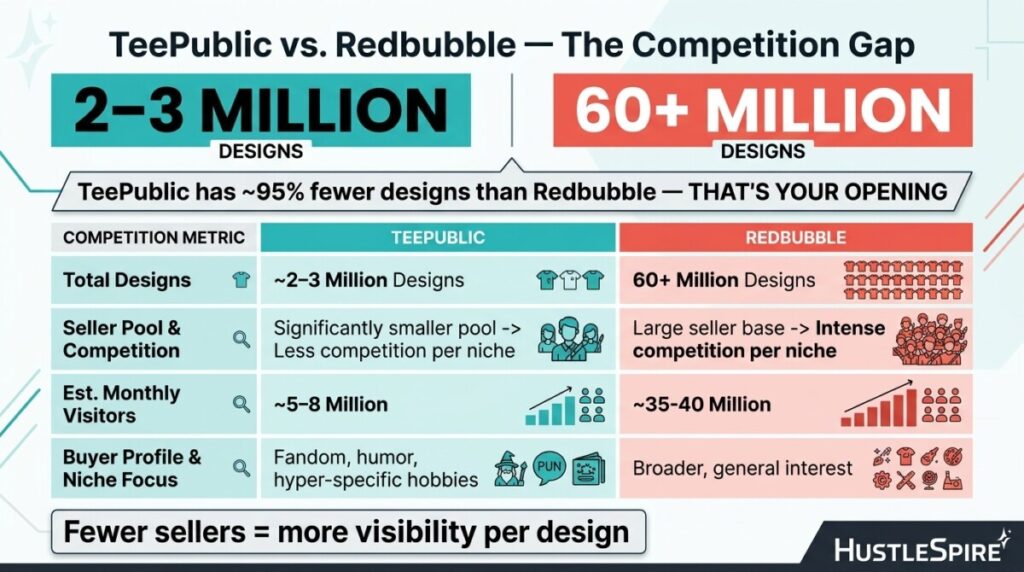
While everyone piles into Redbubble and Merch by Amazon, TeePublic quietly sits with a smaller seller pool and a buyer base that actually converts. The TeePublic selling strategy most people overlook is this: the platform has roughly 2–3 million designs versus Redbubble’s estimated 60+ million. That’s not a small difference — it’s a structural advantage for anyone willing to show up consistently. Less noise means your designs get found. And getting found means getting paid.
What Most Sellers Get Wrong About TeePublic’s Model
Most print-on-demand sellers treat TeePublic like a Redbubble clone. Upload the same designs, use the same tags, and expect the same results. That’s the wrong approach entirely.
TeePublic has a distinct buyer culture — it skews heavily toward fandom, pop culture, humor, and hyper-specific hobby communities. Broad, generic designs that might scrape by on Redbubble die quietly on TeePublic. However, a well-targeted design for, say, competitive chess players or vintage synthesizer collectors can rank on the first page within days. The platform rewards specificity in a way that broader marketplaces simply don’t.
Additionally, TeePublic’s relationship with Redbubble (it’s owned by the same parent company) means the two platforms share infrastructure but maintain separate catalogs and separate audiences. Your TeePublic uploads don’t automatically appear on Redbubble — you need to manage them independently.
The TeePublic Selling Strategy That Actually Works
Point 1: Understand the real margin structure before you upload anything.
Standard tees on TeePublic retail at $20 and pay artists $4 per sale during promotional periods—and TeePublic runs promos constantly. At full price ($35 for premium tees), you earn $11. The math works in your favor when you focus on premium products: hoodies ($45–$55 retail, $13–$18 artist earnings) and long sleeves rather than chasing volume on standard tee sales during discount windows. One seller I know restructured her entire catalog around hoodies and sweatshirts and doubled her monthly earnings without uploading a single new design.
Point 2: Target micro-niches with search-first design thinking.
Before opening Canva or any design tool, search TeePublic for your intended niche. Count the results. If a search returns under 500 designs, you’ve found a viable gap. Under 200 results is a strong signal. Design specifically for what those buyers are already typing—job titles, regional humor, obscure hobbies, specific decades. A “1970s Radio DJ” design will outperform a generic “music lover” shirt every single time on this platform.

Point 3: Use TeePublic’s collection feature as a discoverability tool.
Collections on TeePublic function like curated storefronts within your shop. Group designs by theme — “Gifts for Teachers,” “Hiking Humor,” “Retro Gaming” — and TeePublic surfaces these collections in browse and recommendation flows. Most sellers ignore this feature entirely. Sellers who actively build and title collections with searchable terms report 20–35% more organic shop visits, according to community data from TeePublic seller forums. It takes 15 minutes to set up and requires zero additional uploads.
Point 4: Cross-list strategically, don’t cross-list everything.
If you’re already on Redbubble or running a print-on-demand income strategy across multiple platforms, be selective about what you bring to TeePublic. Your top 20% of performing designs on other platforms — the ones with proven buyer demand — are your TeePublic starting point. Don’t flood the platform with 300 untested uploads hoping something sticks. Quality signals on TeePublic matter more than catalog size, at least in the first 6 months.
Creators also care about how quickly platforms actually pay them. That comparison is explained in Sellfy vs. Gumroad vs. Stan Store: Which Platform Actually Pays You Faster?.
TeePublic’s Limitations Are Real
The promotional pricing model is genuinely frustrating. TeePublic seems to run a sitewide sale every other week, which means your $4 standard tee royalty is more common than your $11 full-price royalty. If you’re expecting consistent premium earnings, budget your expectations accordingly—assume 60–70% of your sales will happen at promotional pricing.
Traffic is also lower on Redbubble overall. Sellers who rely solely on TeePublic typically cap out around $300–$600/month unless they actively drive external traffic through social media or email. For comparing the best print-on-demand platforms for your specific goals, TeePublic works best as part of a multi-platform strategy — not a solo play.

One Search, One Design
Go to TeePublic right now and search three micro-niches you know something about—a profession, a hobby, a regional identity. Count the results for each. Pick the one with the fewest designs and the most obvious buyer intent. Create one targeted design this week using the exact language buyers are already searching. Upload it with a keyword-rich title and 10 specific tags. That’s your TeePublic experiment — and it costs you nothing but an afternoon.
Many entrepreneurs discover profitable online models only after exploring different digital income paths. One surprising example is shared in They Said Dropshipping Died in 2025—Then I Found The Loophole Making $4K/Week.
