

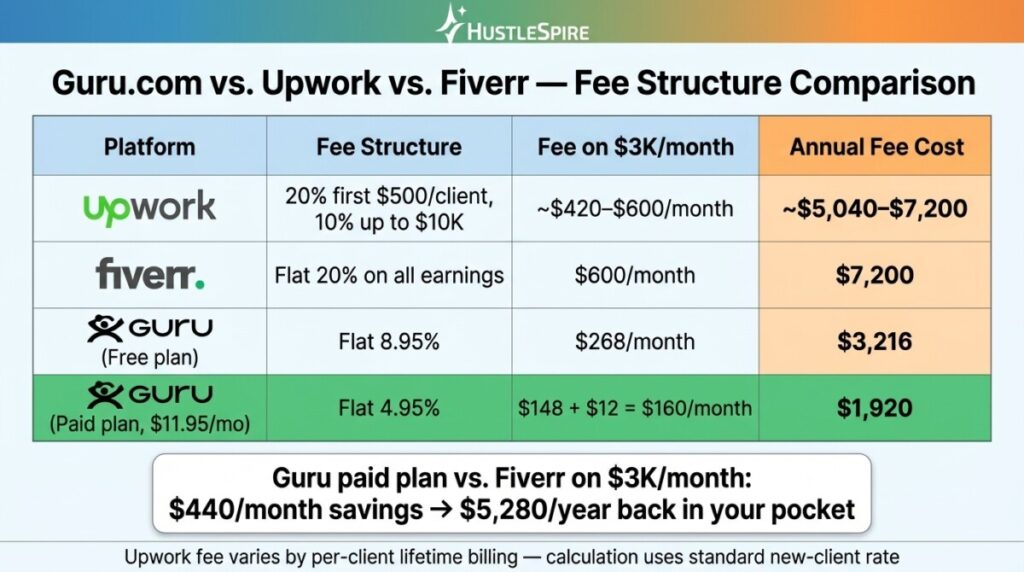
While everyone fights over scraps on Upwork and races to the bottom on Fiverr, Guru.com has been quietly doing something different. The Guru.com freelance platform has existed since 1998 — older than most of its competitors — and it’s currently benefiting from something neither Upwork nor Fiverr can easily replicate: lower competition density and a fee structure that keeps more money in the freelancer’s pocket. Upwork takes up to 20% of your earnings. Guru’s fee starts at 8.95% and drops as low as 4.95% for high-volume earners. That’s not a small difference over the course of a year.
What Most Freelancers Get Wrong About Guru.com
Most freelancers wrote Guru off years ago because it looked dated compared to Upwork’s slick interface. That’s a surface-level judgment that’s costing them real money.
Guru’s buyer base has never disappeared — it just gets less attention from the freelance community, which means less competition per job posting. The average Upwork proposal gets 20–50 competing bids. On Guru, many mid-tier jobs attract 5–12 proposals. That’s not because the work is lower quality — it’s because most freelancers are too busy competing on overcrowded platforms to notice a functioning alternative. Additionally, Guru’s WorkRoom feature gives freelancers a structured project management environment per client, which reduces miscommunication and scope creep better than a basic messaging thread.
Why the Guru.com Freelance Platform Deserves a Second Look
Point 1: The fee structure rewards consistency in a way Upwork doesn’t.
Upwork charges 20% on your first $500 with each client, dropping to 10% at $500–$10,000 and 5% above $10,000. The math punishes you hardest when you’re new or working with new clients frequently. Guru.com charges a flat 8.95% on the free membership plan—no sliding scale based on per-client history. Upgrade to a paid membership ($11.95–$49.95/month), and that fee drops to 4.95%. For a freelancer billing $3,000/month across multiple clients, the fee savings versus Upwork’s standard 20% tier can amount to $300–$400/month—real money that compounds over a year.
Point 2: Guru’s SafePay system protects both sides of the transaction—and clients know it.
Guru uses a funded escrow system called SafePay. Before work begins, clients fund the milestone—the money sits in escrow and is released to the freelancer upon approval. This isn’t unique to Guru, but Guru’s implementation is transparent and well-established, giving clients a reason to trust first-time freelancer relationships on the platform. One copywriter I know landed a $2,800 content project with a U.S.-based manufacturer who had never used freelance platforms before—the client cited SafePay’s funded escrow as the reason they felt comfortable transacting. First-time platform buyers are significantly less price-sensitive than veterans, which benefits your rate negotiation.
Many freelancers start by discovering hidden opportunities where demand is high but competition is low. A great example of that is explored in The Fiverr Gigs Nobody’s Selling (But Buyers Are Desperately Searching For).

Point 3: Use Guru’s Quote system strategically—don’t bid like everyone else.
Guru’s job posting system lets freelancers submit quotes with a cover letter, timeline, and proposed rate. Most freelancers submit generic quotes with the same structure as their Upwork proposals. That’s a missed opportunity. Guru buyers tend to be smaller businesses and independent decision-makers, not large procurement teams. Your quote should read like a short business proposal—identify the client’s specific problem in the first two sentences, propose a clear deliverable and timeline, and include a direct pricing line. Freelancers who write client proposals that convert typically close at 2–3x the rate of those sending templated bids, regardless of platform.
Point 4: Build recurring work through the WorkRoom, not just one-off projects.
Guru’s WorkRoom is a per-client dashboard where you manage milestones, invoices, files, and communication in one place. Most freelancers use it passively — they complete the job and move on. The smarter play is to use it as a relationship-building tool: leave detailed milestone notes, deliver work with brief summary memos, and propose follow-on projects before the current one closes. Clients who hire on Guru tend to be operationally focused and appreciate organized vendors. Repeat business on Guru carries zero additional platform fee beyond your membership tier — unlike Upwork, where each new contract period resets the per-client fee calculation. If you’re managing multiple freelance client relationships, Guru’s WorkRoom structure makes that easier than most platforms.
Guru Has Genuine Limitations
Guru’s job volume is lower than Upwork’s—no point pretending otherwise. You’ll see fewer postings per category, and some niche skill sets have thin job boards on the platform. The interface, while functional, hasn’t kept pace with competitor UX updates, and the mobile experience is noticeably weaker.
The platform also has a lower international brand recognition problem — some clients have simply never heard of it, which occasionally creates friction when pitching your services elsewhere and mentioning Guru as a portfolio reference. It works best as a complementary platform alongside your primary marketplace, not as your only income source. Use it where Upwork competition is pricing you out—it’s a volume and margin play, not a replacement strategy.
As freelancers begin to value their time more, they also start looking for better platforms and smarter ways to earn. That mindset is discussed in Why Your Weekends Are Worth More Than You Think.

Build a Profile
Go to Guru.com and create a free account. Build your profile to 100% completion—portfolio samples, skill tags, and a bio that leads with the business outcome you deliver, not your job title. Then browse active job postings in your category and submit three targeted quotes before the end of the week. Write each one as a short business proposal, not a bid. Three well-written quotes on a lower-competition platform will outperform thirty generic bids on Upwork. That’s a testable hypothesis—and the only way to know if Guru is worth your time is actually to show up on it.
