

Most people who search “what is Toptal” are looking for a definition. What they actually need is a decision framework—because Toptal in 2026 is not a freelance marketplace you browse, apply to, and start earning from in a weekend.
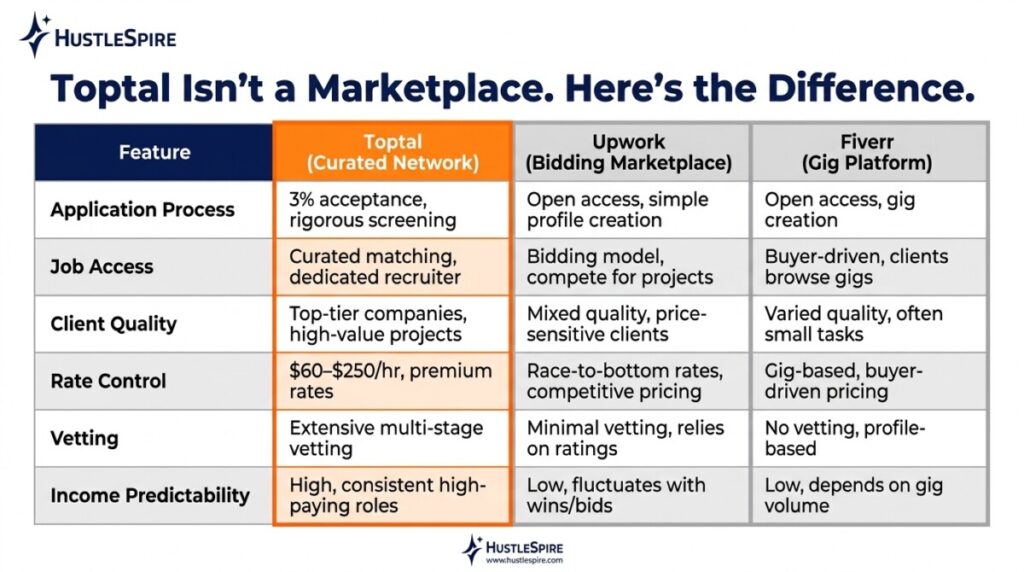
It is a private talent network built around deliberate exclusion, and understanding that distinction is the difference between a wasted application and a well-timed one.
The mistake most freelancers make is treating Toptal like Upwork with a harder sign-up form. They assume the difficulty is technical — that if they sharpen their coding skills or beef up their portfolio, they’ll get in. That assumption costs them the application. The real filter isn’t purely skill. It’s fit. Toptal’s model depends on matching senior-level independent talent with clients who are paying premium rates and have zero tolerance for ramp-up time. The platform isn’t filtering for good—it’s filtering for immediately deployable and communication-ready.
What Toptal Actually Is — and Who Built It For
Toptal is a curated network of freelance software engineers, designers, finance experts, project managers, and product managers. Founded in 2010, it operates as the intermediary between high-growth companies and the senior independent talent that these companies can’t easily hire full-time. In 2026, Toptal serves clients ranging from funded startups to Fortune 500 companies who need demand specialists — not generalists on retainer.
The platform does not function like a job board. There are no public listings you scroll through. Once accepted, you are matched to clients by Toptal’s internal team based on your skills, timezone, communication style, and availability. The match is curated, not algorithmic. That distinction matters because it means your income potential after acceptance depends partly on how well your profile is built, not just on how talented you are.
What Is Toptal’s Acceptance Rate — and Why the 3% Number Is Incomplete
Toptal’s 3% acceptance rate is the most-cited statistic about the platform — and the most misunderstood one. It applies to cold applicants: people who find the platform independently and apply without a referral or prior relationship. Referred candidates clear the same screening process at nearly five times that rate. The 3% is real, but it describes a specific entry path, not the platform’s ceiling.

The screening itself has four stages. First, a communication and personality evaluation—Toptal explicitly screens for how well candidates explain their thinking under pressure, not just whether they can solve a problem. Second, a timed technical or domain-specific test. Third, a live interview with a senior Toptal member. Fourth, a two-week paid engagement with a real client, which serves as the final filter. Candidates who clear all four stages are formally accepted into the network. That process typically takes four to six weeks from first application to final decision.
What Toptal Pays and Whether the Rates Are Real
Toptal freelancers set their own hourly rates, and the platform takes a cut before clients pay. Typical rates in 2026 range from $60 to $200 per hour for engineers and $80 to $250 per hour for finance professionals, depending on specialization and seniority. These aren’t aspirational numbers — they reflect what clients on the platform expect to pay for senior-tier expertise delivered without friction.
The tradeoff is volume. Toptal does not guarantee ongoing work after acceptance. Matching frequency depends on your availability, your specialty’s demand curve, and how well your communication style aligns with client expectations. Some accepted freelancers build six-figure incomes on the platform within their first year. Others accept membership and wait months between engagements. The platform is a high-upside, variable-volume model—not a salary replacement on a fixed schedule.

Toptal is genuinely worth pursuing for the right person at the right stage. The right person has three to five years of specialized experience, communicates with precision, and doesn’t need hand-holding on client relationships. The wrong stage is when you’re still building core competency—applying early to “see how far you get” wastes a clean application attempt and a first impression that’s hard to reset. Toptal does allow re-applications, but each rejection leaves a record. Go in when you’re ready, not when you’re curious.
Before you apply to Toptal in 2026, answer one honest question: Can you walk a senior client through a complex technical or financial decision in real time, under pressure, with no prep? If yes, your next step is auditing your profile for the three things. Toptal screeners actually look for specific outcomes, communication clarity, and domain depth. Start that audit today, and match it against Toptal’s listed specialties to confirm your category has active client demand before you enter the funnel.
