

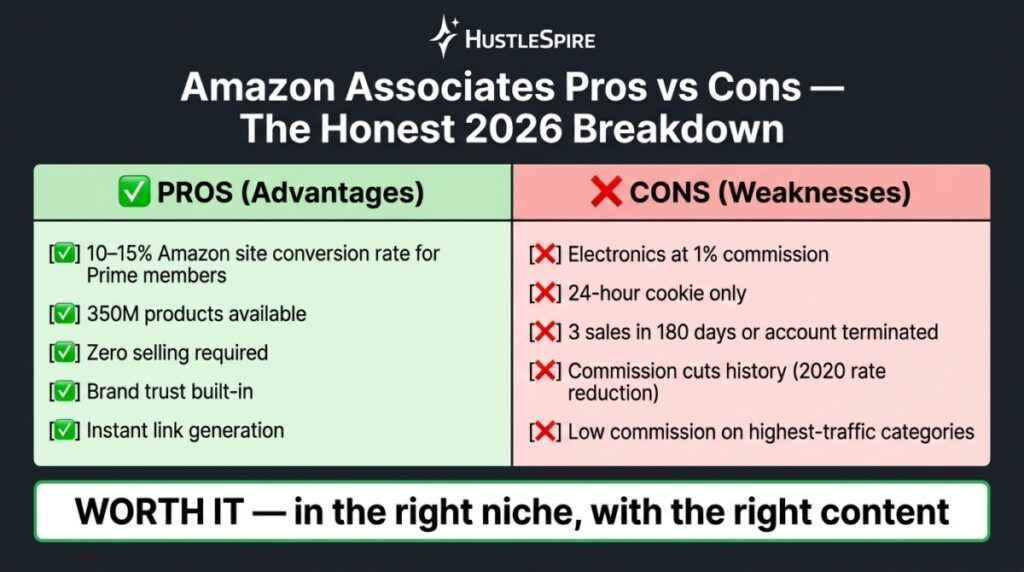
Amazon Associates is simultaneously the most recommended affiliate program for beginners and the one most likely to disappoint them. The promise sounds straightforward: join free, link to any of 350 million products, earn commissions automatically. The reality involves a 1% commission rate on electronics, a 24-hour cookie window that expires before most people finish deliberating, and a 180-day probationary period that terminates your account if you don’t generate 3 qualifying sales. For new bloggers deciding whether Amazon Associates is worth it in 2026, the honest answer is: it depends entirely on how you use it—and most beginners use it wrong from the start.
What Amazon Associates Gets Right for New Bloggers
The program’s single biggest advantage is trust. Amazon converts browsers into buyers at a rate most direct brand programs can’t match—estimates put Amazon’s conversion rate at 10–15% for Prime members.
When someone clicks your affiliate link and lands on Amazon, the purchase friction is nearly zero. Saved payment details, one-click ordering, Prime delivery—the platform does the selling for you.
For new bloggers, that conversion infrastructure matters enormously. You don’t need to convince anyone that Amazon is legitimate. You don’t need to explain the checkout process. You’re borrowing one of the world’s most trusted retail environments and earning a referral cut in return.
The product catalog breadth is also genuinely unmatched. Whatever your niche—home office, pet care, fitness, beauty, kitchen, or hobby—Amazon has relevant products you can link to without building separate relationships for every brand you mention. That simplicity has real value when you’re starting out and want to monetize content without managing a dozen separate dashboards simultaneously.
Where Amazon Associates Falls Short in 2026
The commission structure is the program’s most significant structural weakness, and no amount of traffic volume fixes it in the wrong category.
Electronics — one of the most searched product categories online — pays 1% commission. A $500 laptop sale earns you $5. A $300 monitor earns $3. You’d need to drive 200 laptop sales per month to earn $1,000 from that category alone, which requires traffic volumes that new bloggers won’t see for 12–18 months minimum. Meanwhile, the Luxury Beauty category pays 10% — twenty times the rate — and a single $200 skincare set sale earns $20 with a fraction of the traffic required.
The 24-hour cookie window compounds this problem. If someone clicks your link, gets distracted, and returns to buy the same product 36 hours later, you earn nothing. This structurally favors buying-intent content — “best ergonomic chair under $300” — over awareness content — “how to set up a home office.” The closer someone is to purchasing when they click, the more that 24-hour window works in your favor.
The 180-day probationary rule is the third real risk. Amazon requires 3 qualifying sales within your first 6 months, or they will close your account. New bloggers with low traffic regularly get terminated before they’ve had a fair shot at building income. If this happens, you can reapply — but it’s a frustrating reset that catches many beginners off guard.
How to Make Amazon Associates Worth It From Day One
Given these structural realities, here’s how to use the program effectively rather than just hopefully.
1. Choose a high-commission, high-AOV niche before writing a single post.
The commission rate multiplied by the average order value is the only math that matters for Amazon Associates income. Luxury Beauty at 10% on $150 AOV produces $15/sale. Home improvement at 3% on $200 AOV produces $6/sale. Pet supplies at 3–8% with frequent repeat purchases compound over time differently than one-time electronics buys. Study Amazon’s public commission rate table before committing to a niche—it should directly influence your content direction. For a detailed niche-by-niche breakdown, the best niches for Amazon Associates affiliates in 2026 post covers every major category with realistic income math.
2. Build buyer-intent content as your primary affiliate format.
The content types that survive Amazon’s 24-hour cookie window are comparison posts, “best X for Y” roundups, and specific product reviews that target searchers already in purchase mode. “Best standing desk under $400 for small apartments” is buyer intent. “How standing desks improve productivity” is awareness content. Both have value, but only one reliably converts inside a 24-hour window. Prioritize buyer-intent posts in a 70/30 ratio against awareness content, especially in your first 6 months.
3. Stack Amazon with a zero-gatekeeping platform to protect your income.
Amazon Associates should never be your only affiliate relationship. The account termination risk, cookie limitations, and commission structure all argue for running a complementary platform alongside it from day one. Benable offers no follower minimum and instant approval — you can be earning from Benable recommendation lists in the same week you’re waiting for Amazon’s 180-day clock to tick. Some categories pay higher rates on Benable than Amazon, making it a genuine upgrade in certain niches rather than just a backup.

4. Solve the 3-sale probation problem with a warm audience, not cold SEO traffic.
New bloggers relying entirely on Google organic traffic to generate their first 3 Amazon sales in 180 days are gambling with their account status. SEO traffic takes 3–6 months to develop meaningfully. Instead, use your email list, TikTok bio link, or Telegram channel to drive your first qualified clicks to Amazon-linked content. A small warm audience converts at significantly higher rates than cold search traffic. Building that warm audience in parallel with your blog is the foundation of a multi-platform affiliate income strategy that doesn’t depend on any single channel working perfectly.
The Verdict on Amazon Associates for Beginners
Amazon Associates is worth joining in 2026 — but only if you go in with a clear niche strategy, buyer-intent content, and a complementary affiliate platform running alongside it.
Used naively—wrong category, awareness-first content, no warm audience—it will produce $15/month and a terminated account at month six. Used strategically—high-commission niche, buying-stage content, multi-platform distribution—it becomes a reliable foundation that compounds as your traffic grows.
The bloggers earning $800–$2,000/month from Amazon Associates aren’t doing anything exotic. They picked the right category, wrote for buyers, not browsers, and didn’t rely on Amazon alone. That’s the entire playbook. If you want to understand where Amazon Associates fits in a broader income picture, the beginner’s guide to side hustle income models maps out exactly how affiliate marketing sits alongside other revenue streams.

Before You Apply
Before you click “Join Amazon Associates,” open their public commission rate table and identify which of your planned content topics fall into a category paying 4% or above. If your primary niche sits at 1–2%, either pivot the niche or plan to layer in higher-commission categories from the start.
That 10-minute audit will determine whether Amazon Associates becomes a meaningful income stream or a frustrating experiment. Do it before you write a single post around affiliate links you’ll later need to replace.
