

Starting a print-on-demand business in 2026 doesn’t require thousands in upfront inventory or a warehouse full of products. It’s one of the lowest-barrier entry points into e-commerce, but that accessibility comes with trade-offs most beginners don’t anticipate. If you’re financially constrained but willing to put in strategic work, print-on-demand can generate income—but not overnight, and not without understanding the real mechanics behind it.
This isn’t a get-rich-quick model. It’s a skill-building framework where you learn design, marketing, customer psychology, and platform navigation. The people making consistent money aren’t just uploading random designs and hoping for sales. They’re treating it like a business: researching demand, testing ideas, optimizing listings, and iterating based on data.
Here’s what print-on-demand actually looks like in 2026—no hype, no shortcuts, just the operational reality.
What Print-on-Demand Actually Means
Print-on-demand is a fulfillment model where products are manufactured only after a customer places an order. You design the graphics, upload them to a platform, and when someone buys, a third-party supplier prints and ships the item directly to the customer. You never touch inventory.
Common products include t-shirts, hoodies, mugs, phone cases, tote bags, and wall art. Platforms like Printful, Printify, and Redbubble handle production and shipping. You handle design and marketing.
The appeal is obvious: zero upfront inventory costs, no storage fees, no shipping logistics. But the trade-off is equally clear: lower profit margins and less control over production quality and fulfillment speed.
The Real Costs (Beyond the “Zero Investment” Myth)
While you don’t need to buy inventory upfront, calling print-on-demand “free” is misleading. Here’s what you actually need:
Design tools: Canva Pro ($13/month) or Adobe Creative Cloud ($55/month) if you want serious design capability. Free tools exist, but they limit quality and speed.
Platform fees: Most POD platforms are free to use, but some marketplaces charge listing fees or take percentage cuts beyond the base cost.
Marketing budget: Organic traffic is slow. If you want faster traction, expect to spend $100-$300 testing paid ads on Facebook, Instagram, or Pinterest.
Domain and storefront (optional): If you’re building your own Shopify or Etsy store instead of relying solely on Redbubble or similar marketplaces, expect $30-$50/month in platform and app costs.
Time investment: This is the biggest cost. Researching niches, creating designs, writing product descriptions, and optimizing listings takes hours. If you value your time, factor that into ROI calculations.
Starting lean is possible with $50-$100, but realistic budgeting for tools and testing means $200-$500 in the first 90 days.
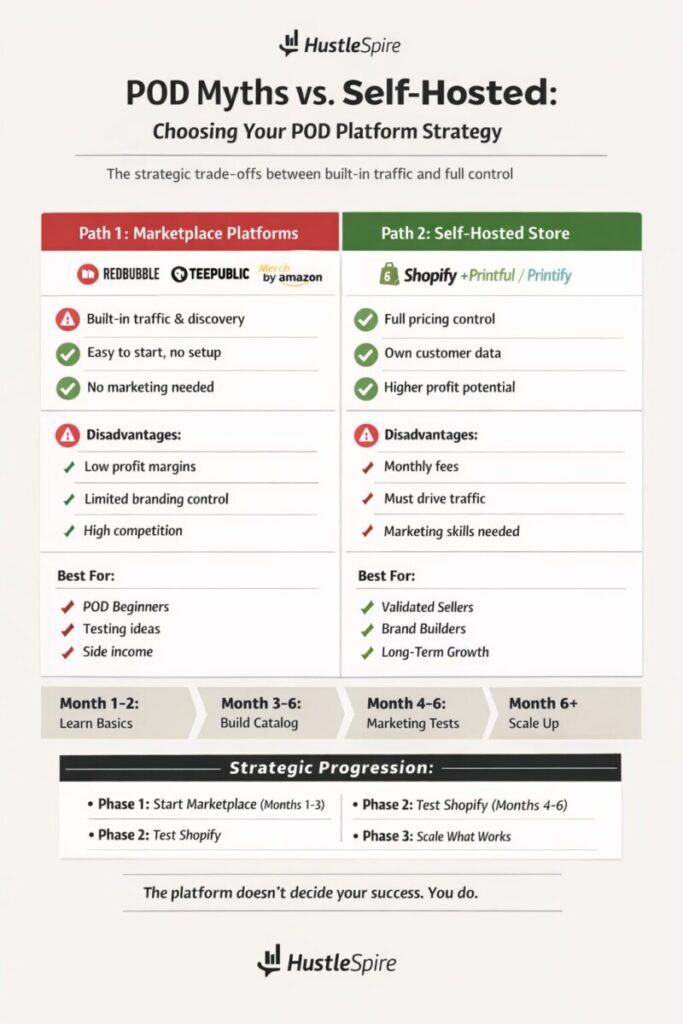
Platform Selection: Marketplace vs. Self-Hosted
You have two main paths in print-on-demand: selling on existing marketplaces or building your own storefront.
Marketplace platforms (Redbubble, TeePublic, Merch by Amazon):
- Built-in traffic and search functionality
- Lower control over pricing and branding
- Higher competition, lower margins
- Best for testing ideas with minimal setup
Self-hosted stores (Shopify + Printful/Printify):
- Full control over branding, pricing, and customer experience
- Requires driving your own traffic (ads, social media, SEO)
- Higher profit margins but more operational complexity
- Best for scaling once you’ve validated demand
Beginners often start on marketplaces to learn what sells, then migrate to self-hosted stores once they have proven designs and know how to drive traffic.
If you’re just starting out and want to explore low-cost opportunities, check out these 10 side hustles you can launch with zero upfront investment– a great way to test your entrepreneurial skills before diving into POD
Design Strategy: Trends vs. Evergreen Niches
The biggest mistake new sellers make is designing what they personally like instead of what the market wants. Print-on-demand is demand-first, creativity second.
Trend-based designs capitalize on viral moments, holidays, or cultural events. They can generate fast sales but have short shelf lives. Examples: election slogans, viral memes, seasonal products.
Evergreen niches target consistent interests that don’t fade: hobbies, professions, pet breeds, humor archetypes. These sell steadily year-round. Examples: “Dog Mom” merchandise, nurse appreciation shirts, hiking-themed mugs.
The sustainable approach combines both: 70% evergreen designs for consistent baseline income, 30% trend-based designs for spikes.
Research tools matter here. Use Google Trends, Pinterest searches, Amazon best-sellers, and Etsy trend reports to identify what people are actively buying—not what you think is cool.
Profit Margins and Pricing Reality
Print-on-demand margins are slim compared to traditional retail. Understanding the math prevents disappointment.
Example breakdown (basic t-shirt):
- Base cost (printing + shipping): $12-$15
- Your selling price: $22-$28
- Platform fee (if applicable): $1-$3
- Net profit per sale: $5-$10
To make $1,000/month, you need 100-200 sales depending on your product mix and pricing strategy. That requires either high traffic volume or a focused niche with loyal repeat buyers.
Higher-margin products exist: hoodies, all-over print items, and premium materials command better pricing. But they also come with higher base costs and narrower audiences.
The key is product diversification. Relying solely on t-shirts limits income potential. Expand into mugs, posters, phone cases, and tote bags to capture different customer preferences and increase average order value.

Marketing: The Part Most Beginners Underestimate
Uploading designs isn’t enough. Without traffic, even great designs sit unseen.
Organic strategies:
- Pinterest: Create design mockup pins linking to products
- Instagram/TikTok: Share design processes, niche humor, relatable content
- SEO optimization: Use keyword-rich titles and tags on marketplace listings
Paid strategies:
- Facebook/Instagram ads targeting specific interests and demographics
- Pinterest promoted pins for visual products
- Google Shopping ads if you’re running a Shopify store
The fastest path to first sales combines both: organic content builds long-term presence while small paid tests ($5-$10/day) validate which designs convert.
Most successful POD sellers treat social media as a discovery engine, not just a promotion tool. They create content their target audience wants to see, then soft-sell products within that ecosystem.
Common Pitfalls That Kill Momentum
Overdesigning too early: Creating 100 designs before testing any of them wastes time. Start with 10-20 strong concepts, see what sells, then expand.
Ignoring niche specificity: Generic designs like “Be Kind” or “Good Vibes Only” drown in competition. Hyper-specific niches (e.g., “Corgi owners who hike”) have smaller audiences but higher conversion rates.
Neglecting product descriptions: Marketplace algorithms prioritize well-written, keyword-optimized listings. Thin descriptions tank your visibility.
Expecting passive income immediately: Print-on-demand requires active iteration. You test, analyze, adjust, and repeat. Income becomes passive only after you’ve built a catalog of proven sellers.
Copying trending designs exactly: Trademark and copyright issues are real. Avoid brand names, celebrity likenesses, and copyrighted phrases. Create inspired-by variations, not replicas.
Timeline Expectations: What 90 Days Actually Looks Like
Month 1: Platform setup, niche research, first 10-20 designs uploaded. Goal: 1-5 sales to validate you understand the basics.
Month 2: Analyze what sold (or didn’t). Create 20 more designs based on insights. Begin small paid ad tests. Goal: 10-20 sales, identify 2-3 winning products.
Month 3: Scale winning designs. Add product variations (colors, styles). Expand to additional platforms or products. Goal: 30-50 sales, refine marketing approach.
This is realistic progression. Anyone promising $5K in month one is selling courses, not running actual POD businesses.
Is Print-on-Demand Worth It in 2026?
For someone with limited capital but willingness to learn, yes—if expectations are grounded. Print-on-demand teaches valuable skills: design, market research, copywriting, paid advertising, and customer psychology. These skills transfer to other online business models.
It won’t replace a full-time income in 90 days. But with consistent effort, $500-$2,000/month within six months is achievable. Scale beyond that requires either significant traffic generation skills or transitioning to a self-hosted store with better margins.
The people who succeed treat print-on-demand as skill-building infrastructure, not a lottery ticket. They test, learn, iterate, and gradually build a catalog of products that generate income with decreasing active effort over time.
If you’re broke but ambitious, print-on-demand offers a real path—just not the easy one most YouTube thumbnails promise.
For those looking to turn their first designs into real income, this beginner’s roadmap to making your first $1,000 online is a practical guide to get started and stay on track.

