

Side hustlers celebrate revenue milestones. “$5,000 month!” gets posted. What rarely gets mentioned is what came out the other side after platform fees, software subscriptions, ad spend, and tool costs. Tracking profit vs. revenue isn’t an accounting technicality — it’s the difference between knowing your business is growing and just feeling like it is. Patterns among side hustlers who stall out consistently show the same root cause: they’re optimizing for the number that looks good, not the number that matters.
What Most Side Hustlers Get Wrong About Their Own Finances
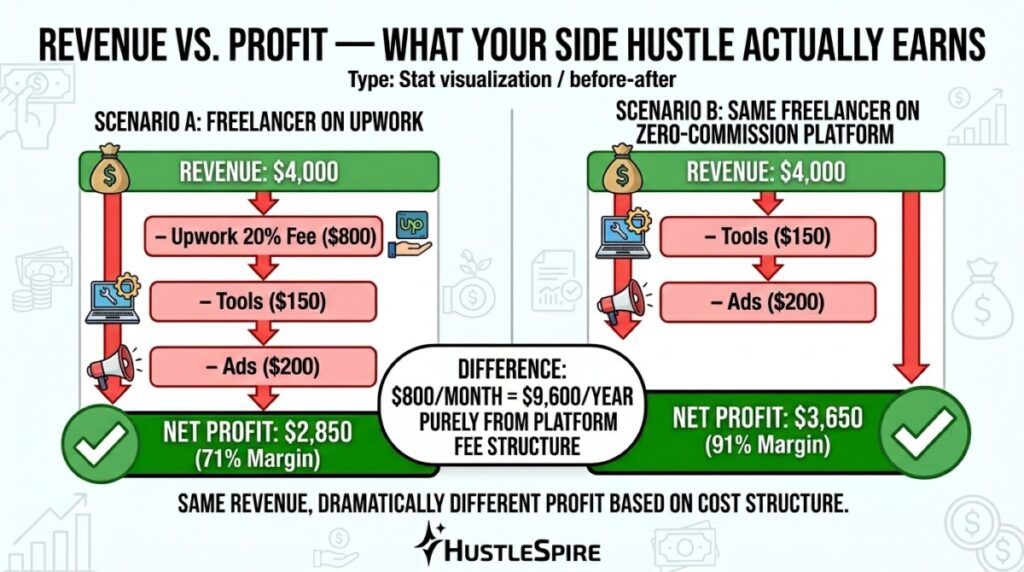
The instinct is to track incoming money and assume the rest works itself out. It doesn’t. A freelancer billing $4,000/month who pays Upwork 20%, runs $150/month in software, and spends $200 on ads is netting closer to $2,850 — a margin of roughly 71%. That same freelancer on a zero-commission platform with lower tool overhead might net $3,600 on identical revenue. The gap between those two numbers is a strategic business decision, not just accounting.
Revenue tells you how busy you are. Profit tells you how viable your business actually is. Most side hustlers don’t know their real profit margin until they sit down and calculate it — and when they do, the number is almost always lower than expected.
Many entrepreneurs only realize the importance of profit after testing different tools and systems in their business. That journey is similar to what’s shared in 50 Tools That Turned My Side Hustle Into a $15K/Month Business (Bookmarked by 100K People).
How to Start Tracking Profit Properly Without an Accountant
Step 1: Build a simple monthly profit and loss tracker in a spreadsheet.
You don’t need accounting software to start. A Google Sheet with four columns—Income, Platform Fees, Fixed Costs, Variable Costs — gives you a working profit and loss view within 30 minutes. Income goes in the top line. Platform fees (Upwork, Fiverr, Etsy, and Gumroad commissions) go in the next row. Fixed monthly costs — subscriptions, tools, hosting — go below that. Variable costs—ad spend, freelancer payments, per-project expenses—complete the picture. Subtract all three cost categories from income, and what remains is your actual profit. Do this every month, and your financial clarity improves faster than any course on money management can provide.
Step 2: Assign every expense to a specific income stream.
Most side hustlers with multiple income sources have no idea which stream is actually profitable. A print-on-demand store generating $800/month in revenue sounds solid until you subtract $45/month for Canva Pro, $29/month for a Shopify plan, and $120 in Facebook ads—leaving $606 net, or about a 76% margin. Compare that to a freelance writing stream generating $600/month with zero overhead — 100% margin — and the strategic priority becomes obvious. Wave (free accounting software) or QuickBooks Self-Employed (~$15/month) both allow you to tag transactions by income category, making this breakdown automatic over time.

Step 3: Calculate your effective hourly rate, not just your billing rate.
Profit margin alone doesn’t tell the full story—time does. A $2,000 project that takes 40 hours of actual work (including client calls, revisions, and admin) pays $50/hour. A $1,200 project that takes 8 focused hours pays $150/hour. Tracking profit without tracking time produces an incomplete picture of which activities are actually worth scaling. Log your hours by income stream for one month using a free tool like Toggl Track and calculate your effective hourly rate per stream. The results often completely reorder what deserves your focus.
Step 4: Set a minimum acceptable profit margin — and cut what doesn’t meet it.
This is the decision most side hustlers avoid because it requires admitting that a revenue stream isn’t working as well as it looks. A reasonable minimum margin for service-based income is 70–80%. For digital products with upfront creation costs, 60% is reasonable once the asset exists. Anything consistently running below 50% margin deserves either a pricing review or a serious question about whether it’s worth the continued time investment.
Focusing on profit instead of just revenue is also connected to working smarter, not harder. This idea is explained clearly in How to Apply the 80/20 Rule to Your Side Hustle (Make More, Work Less).
Why Most People Avoid This Exercise
Looking at profit clearly is uncomfortable because it often reveals that something you’ve been proud of isn’t actually working. A side hustler doing $3,000/month in Etsy revenue with $2,400 in costs isn’t running a profitable side hustle—they’re running a 20% margin operation that might not survive a platform fee increase. The numbers don’t lie, but they do require the willingness to look. Additionally, tracking this properly takes about 30–60 minutes per month once the system is set up. That’s a small investment that directly informs every strategic decision you make about where to spend your time and money.

Open a Google Sheet right now and create four columns: Income, Platform Fees, Tool Costs, Ad Spend. Fill in last month’s numbers from memory or your bank statements. Subtract the three cost columns from income. That single calculation — your actual profit for last month — is the number your entire hustle strategy should be built around. If you don’t know it, you’re navigating without a map.
